
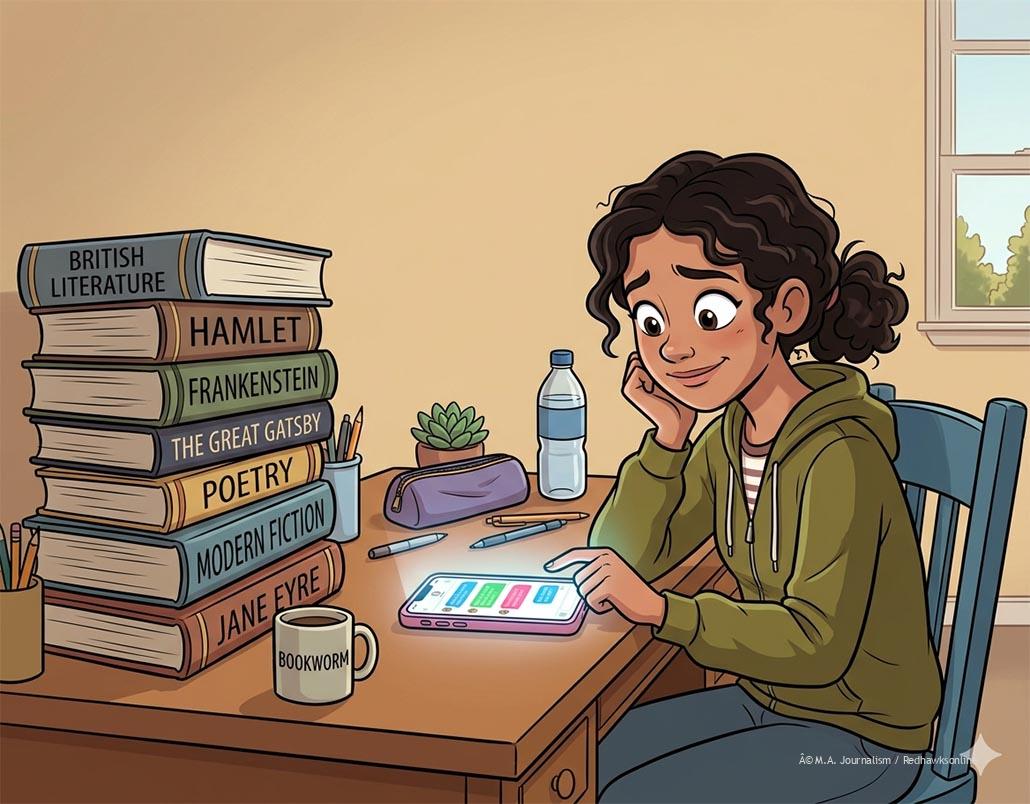

While M.A. students generally do well, teachers address reading stamina
A student sits down to read a short chapter that should take only 20 minutes. Just five minutes in, their phone buzzes. They check it, scroll briefly, and set it back down. When they return to the page, they realize they have to reread the paragraph they just finished. By the time they’re done, nearly an hour has passed, and they are exhausted.
“I have a lot of trouble reading,” said junior Bella Bustamante. “I sit down to read a book, then find I didn’t remember any of the pages, get distracted, and do something else.”
Lately, this experience has become the norm for most readers. While many still purchase books and prefer physical texts to digital ones, there is no denying that reading longer texts has become harder. In the age of digital media, declining reading endurance has become increasingly common, especially among those impacted by fast-paced classes, the lingering effects of the COVID-19 pandemic, and the abundance of alternative forms of entertainment at their fingertips. According to the NAEP (National Assessment of Educational Progress), the reading skills of high school seniors are the worst they have been in three decades.
Book sales strong
While many worry that the decline of physical books is the culprit behind the decline in reading endurance, the book market is actually quite healthy.
According to Precedence Research, the online book market is expected to almost double over the next decade, from $26.04 billion today to more than $48 billion in 2035. Furthermore, while the US book industry has slightly declined in recent years, it is still projected to increase from 24.77 billion dollars to 27.59 billion dollars in 2030, according to Statista.
So, while people are still buying books, the concern seems to be finishing them, particularly longer texts.
“[Students] are not reading as deeply for long periods of time, meaning their stamina has declined,” said MA reading specialist Christina Freeman.
Freeman further explained how academic expectations and pacing could contribute to students’ waning stamina.
“Everything is fast-paced. Everything is in a hurry, and dare I say AP classes are hurried classes that focus on getting through the material fast,” Freeman said. “When we look at the words ‘academic rigor’, we often equate that to moving fast and getting through material, rather than slowing down and really contemplating what we are learning.”
This fast-paced learning environment is especially detrimental to those who already struggle with reading. According to the NAEP, serious declines in reading stamina are often found among students who are already struggling with reading, while students above the 90th percentile haven’t experienced as severe a decline.
Audio books are popular
Furthermore, as reading stamina continues to decrease, attention has turned to alternate ways for students to consume content, such as audiobooks. Audiobooks sales are expected to skyrocket in the coming years, rising from $4.2 billion to a staggering $39 billion in 2033, according to Market.US.
But how effective are audiobooks as a replacement for traditional reading? Teachers said they can be very helpful for people with dyslexia or other reading disabilities and can even help students improve their skills when reading print books.
“It depends on how someone intends to take in that information or wants to appreciate the book,” said MA librarian and chair of the English Department Robyn Westrem. “If someone wants to get better at reading or become more fluent, or read more efficiently, I think it is better to have a print book in front of you as you listen.”
While many might find audiobooks situational or a step down from physical texts, others think they are on par with a paper copy.
“I think it’s actually a weird argument that listening to a book isn’t the same as reading a book,” said MA English teacher Michaela Bieno. “As an English teacher who values reading, I think it’s gross in any capacity to tell someone that pursuing knowledge in a way that other people don’t deem credible is ridiculous.”
Impact of AI
Audiobooks are not the only alternative reading source that has taken students by storm; AI has rapidly crept into many subjects, including English, for better and worse. Pew Research studies show that 55% of Americans regularly use AI, with 65% of users being Millennials or Gen Z. Furthermore, 58% of high school students reportedly use AI.
While the widespread use of AI has brought many benefits, such as personalized learning experiences and immediate feedback on assignments, it has also posed unique challenges for the English department.
“I would say using AI is fine under certain circumstances, but I think it’s still in the beginning stages of reliability,” said Westrem. “Let’s say students are trying to find quotes from a book through the use of Chat GPT or Gemini; it isn’t reliable, and it’s a shortcut that we wouldn’t recommend.”
While AI might seem like a tool that has brought more harm than good, students have many reasons why AI can be beneficial.
“I don’t personally use AI for my homework,” said junior Jackson Verdoorn. “However, I think it’s great for making outlines or organizing my thoughts.”
While there are many suspected causes for the decline in reading stamina, the pandemic has most certainly left lasting effects on more recent generations of students. According to Stanford University research, the overall reading skills of second- and third-graders decreased by 30% during the pandemic. This lack of foundation in pivotal years could help explain the decline in reading ability.
MA English teacher Kristofor Sauer personally experienced these issues in his own family.
“[During the pandemic], you had kids who were stalling in terms of their ability to progress in their reading, and we are just now seeing those after effects,” Sauer said. “Specifically for people who were learning to read, which was my own kids, the lack of direct instruction that could happen was really, really troublesome.”
Classroom strategies
While it is clear that many problems are plaguing students’ reading, what solutions are teachers implementing to address these issues? Upon starting her job at MA, English teacher Michaela Bieno immediately noticed that many students were struggling with reading endurance, and quickly devised a plan to support them.
“First semester, I put in a schedule so that every day they [start class] with independent reading,” said Bieno. “I think that it’s hard at the beginning of the year, because they’re not expected to, and that slowly transitions into over double the amount of time they’re able to sit and read.”
This idea quickly spread throughout the English department and was proposed as a department-wide activity across all classes.
“Almost the entire English department has adopted some form of independent reading, and I think all of us are reaping the rewards of giving time to that,” Bieno said. We are also [teaching] kids that they actually enjoy certain genres or styles of writing, and I think it builds a lifelong value of literature that maybe kids weren’t expecting to have or find.”
Overall, as reading declines, it is more important than ever for people to read. If you’ve made it this far, consider yourself ahead of the game!