

Balance between tradition and innovation make this production effective
(This review won first place in the annual Journalism Day at the Guthrie, sponsored by Journalism Educators of Minnesota.)
“To be or not to be?” That is the question that has haunted both theatergoers and casual readers alike since William Shakespeare’s Hamlet debuted at the Globe Theater nearly four and a quarter centuries ago. A historic work of art that needs no introduction, the play possesses a storied history marked by the seemingly endless retellings, reimaginings and reinventions that have cluttered the stage, screen and printing press since the curtains first opened on the gloomy prince of Denmark.
The Guthrie Theater itself, currently hosting a revival of Hamlet, is no stranger to this history; the ongoing production, which runs through May 21, is the fifth time the play has graced their stages. Five different performances, five slightly different interpretations of the source material, five plays that beg the question: What’s the point of doing Hamlet again?
While the cynic in me suggests it is merely being performed as a prestige piece, actually viewing the show has pulled me away from that perspective. As a high-budget, high-brow Shakespeare play, it serves as a grandiose showpiece for the theater’s respectability, but that doesn’t negate the genuine enjoyment it creates. The two can be true at the same time, and Hamlet maintains both purposes brilliantly.
Although there are few practical performance choices that haven’t been made already by some other production, Hamlet continues to be performed (and performed enjoyably) simply because it’s a great story, and great stories always have value. At its core, it’s a tragedy about a fractured family, grief and political manipulation, themes which are universally and continually resonant. Shakespeare’s work holds up so well to revival because, although the language is dated, the message, characters and narrative remain intriguing and relatable, something the Guthrie is deftly aware of.
The theater has clearly taken care to preserve the audience’s comprehension, and they have done a phenomenal job balancing elements both updated and original so it is understandable to a modern crowd. Most impressive is their ability to temper some of the more difficult parts of the language without cheapening the material. Actors move, speak and gesture with sharp intentionality.
The dialogue is almost less important than the tone it is delivered in, which cultivates meaning out of the madness of Shakespearean conversation. Subtle pulses of bass lurking beneath the words convey a sense of unease in key moments, creating a memorably uncomfortable “To be or not to be” soliloquy among others.
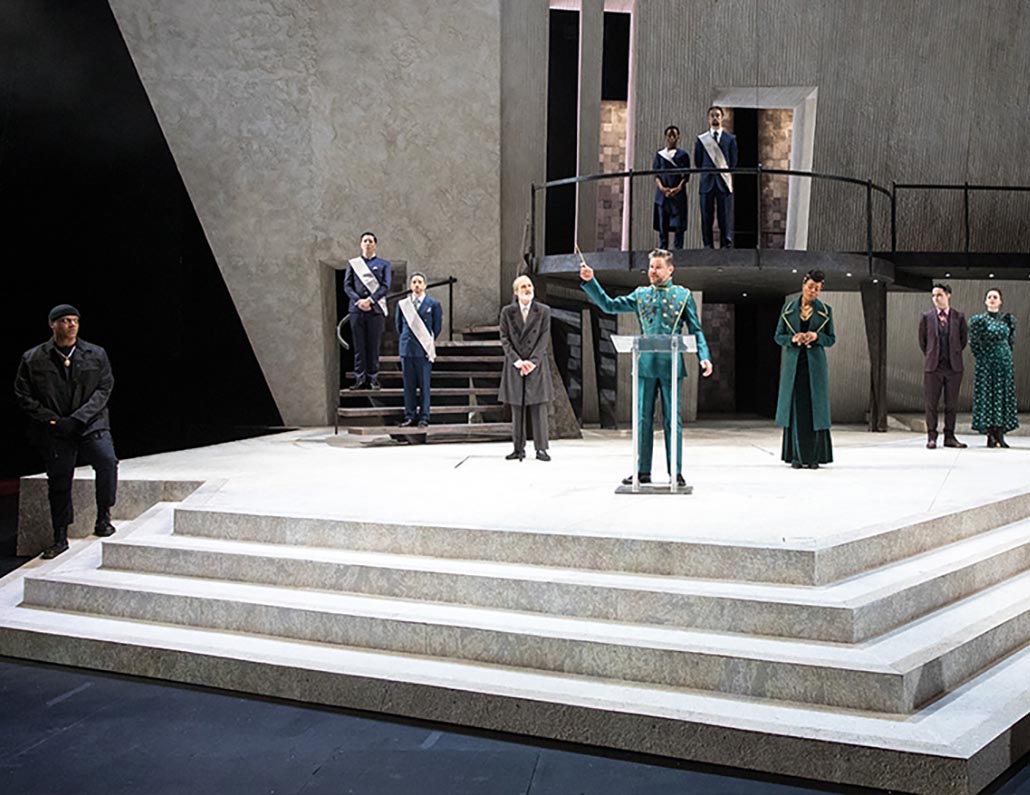
At one point, Claudius delivers a speech to a press conference, complete with (imagined) reporters and a TV audience. The addition fits the modernized, urban aesthetic of the sets and costumes, but it also serves to deepen the audience’s understanding of the characters. Claudius and his wife, Gertrude, are putting on a show for the nation, posing photogenically for the cameras while covering up the rotten reason for his ascension to the throne. They are stately, glamorous, impeccably dressed, and convincing, similar to modern day celebrities and politicians. It is only until Hamlet himself confronts Gertrude about her treachery in her bedroom that she appears in a humble bathrobe, and her respectable veneer is peeled away with her fine dresses.
Updated in look but not language, with a brutal, almost dystopian set and stark music design, Hamlet may be a hard sell for some, especially non-Shakespeare aficionados. Nevertheless, it is a show worth seeing, not because it goes a completely new direction with the material, but because it doesn’t, instead balancing clever innovation with the classical style and dialogue that has given Hamlet its longevity. It is a retelling of a story that has been tirelessly retold, but it stands out as an incredibly singular and effective version.