


The impact of taking a personal finance class at Minnehaha
Personal Finance has been a staple class at Minnehaha for many years now. The course’s content covers many topics crucial to successfully managing financial decisions throughout students’ lives.
While this course has traditionally been held online in an asynchronous format, this year it is being held in person and taught by Social Studies teacher Julie Johnson. This change was implemented for a couple of reasons, but the class was never meant to be online in the first place.
By Desmond Berthiaume
“During COVID, when Minnehaha had a lot of students in person, there was that option to study from home,” Johnson said. “At that time, we realized that this was a viable option. Even if it wasn’t the best option to do online, it worked in a pinch.”
Now, five years after the pandemic, the new administration has decided to revert to in-person learning, coming with pros and cons.
”The value of learning how to navigate an online class; the school saw value in that,” Johnson said. “We were also able to get Personal Finance in for students where it was tough for them to get it into their schedules, so it works really well for some people.”
According to Harvard Extension School, “high self-efficacy often leads to success in online courses.” Other benefits include “computer interaction, good time management skills, and a positive attitude toward e-learning.”
According to the University of Illinois Springfield, online learning is “an inappropriate learning environment for more dependent learners.”
Furthermore, students need to be “well organized, self-motivated, and possess a high degree of time management skills to keep up with the course.”
While online classes do have some benefits, Johnson prefers a face-to-face learning environment.
“[The administration] talked to me in late fall and said, if you had a choice, would you stick with online or in person, and I like to be in the room talking to my students face to face, so that was my answer,” Johnson said.
Now that Personal Finance will be switching to an in-person class, students will have the opportunity to learn about finance through a more interactive classroom experience. This is important, as Personal Finance explores several topics critical to college life and beyond. Topics range from stock market investments to loans and more.
“A lot of the things we cover in class are very straightforward and understandable, but they’re not necessarily things you would know on a deeper level unless you are told,” Johnson said.
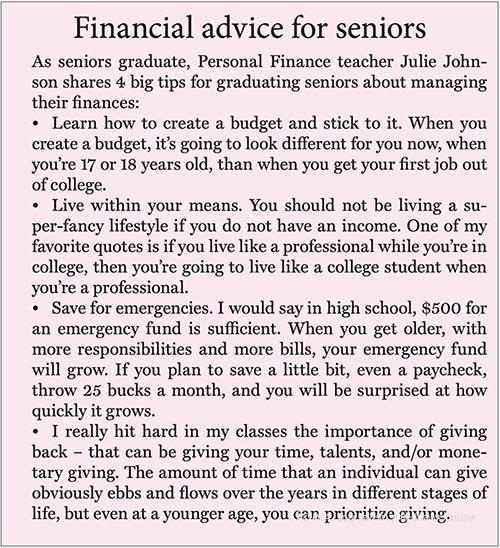
For example, one of the biggest topics covered in the class is budgeting. Johnson admits that many students know that a budget is about organizing your money and knowing the bills you’re paying, rather than what’s coming into your salary. However, Johnson says that not many people fully grasp those ideas until they are brought up in class.
”Personal finance class taught about the stock market,” said senior Josephine Johnson. “I am now able to track my stock with mutual funds,” said Johnson
According to the NEFE, “A large majority of U.S. adults endorse the need for financial education curricula in high schools.”
Furthermore, the latest polling shows that 83% of respondents say the state they live in should require a semester or year-long course focused on personal finance as a graduation requirement.
While Minnehaha hasn’t made personal finance a required course, it remains an important course in the school.
As the course transitions back to a traditional classroom setting, Personal Finance continues to prepare students for many of the financial decisions they will face in their lives.