
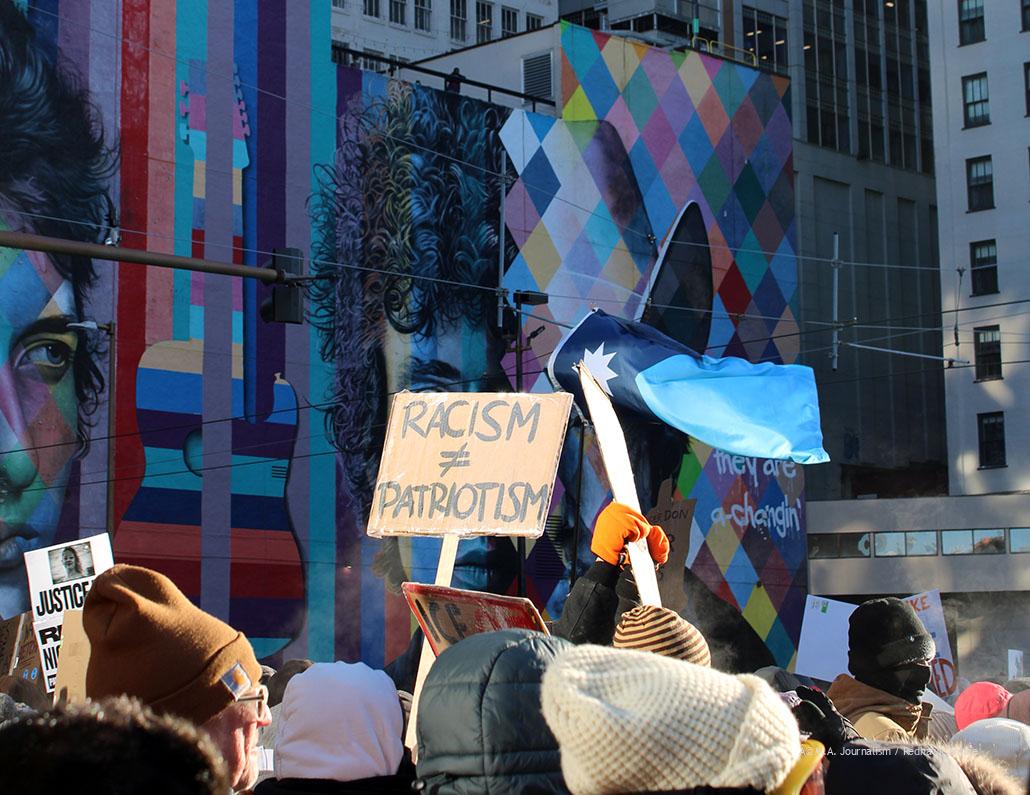

‘Minneapolis already has
enough ICE.’
Sirens
‘Justice for Renee Good’
Shouts
‘STOP ICE’
Shots
‘We Will Keep Fighting’
Protests
‘History Has Its Eyes on You’
Walk-outs
‘ICE OUT of Minneapolis’
Shutdown
‘F YOU, ICE’
Chaos
‘We love our immigrant
neighbors’
Everywhere
‘I thought all lives mattered.’
ICE, or the U.S. Immigration and Customs Enforcement, an agency of the Department of Homeland Security, is responsible for enforcing U.S. borders and regulating immigrants. “The Department of Homeland Security is part of the executive branch, so it’s under the authority of the President,” said Kayleen Berg, government and economics teacher and speech team coach at M.A. “It was formed after 9/11 to coordinate emergency response and border control.”
The Department focuses on countering terrorist attacks and threats to the security of the United States, which, for the Trump administration, involves immigrants. So in December 2025, ICE began “Operation Metro Surge,” and began a centralized effort in the Twin Cities to arrest immigrants. “They have an extensive list of people who they know are in the Twin Cities who do not have legal documentation to be in the United States, who are obviously targets, but then they’re also just trying to arrest people who might be of interest,” said Nathan Johnson, M.A. teacher
of A.P. Human Geography, A.P. European History, and debate team coach. Specifically, ICE’s focus is on criminals in the U.S., or those
who are here illegally, that is, with no temporary or permanent residence permit.
But the presence of 3,000 ICE officers increased tensions, provoked major demonstrations, and most notably, involved the shooting deaths of two U.S. citizens: Renee Good on Jan. 7 and Alex Pretti on Jan. 24. Bystander videos appear to show Good and Pretti protesting ICE activity; federal government statements claim that ICE was acting in self-defense. The shootings and protests have received worldwide attention, putting Minneapolis and St. Paul at the center of global events.
Kristi Noem, the U.S. Secretary of Homeland Security, claimed in a Jan. 19 statement posted by the Department’s website that “10,000 criminal
illegal aliens who were killing Americans, hurting children, and wreaking terror in Minneapolis” have been arrested, and “in the last 6 weeks, our brave DHS law enforcement have arrested 3,000 criminal illegal aliens, including vicious murderers, rapists, child pedophiles, and incredibly dangerous individuals.” Yet these 3,000 to 10,000 “criminal illegal aliens” don’t seem to be the only people either deported or detained.
“ICE has had some conflicting messages,” Berg said. “What we’ve also seen are some people who have temporary visas, or people with court orders allowing them to stay in the country, that are still getting picked up by ICE.”
Besides the rampant deportations, ICE is having an impact on consumerism in the Twin Cities, and people’s daily routines are constantly chang-
ing due to the enforcement’s impact. “Economically, it’s damaging, because there are many businesses that are having to reduce hours or close entirely because employees are scared, unable to come to work, or have been detained,” Johnson said. “And it seems that this has been costing Twin Cities businesses millions of dollars every week.” Lake Street businesses specifically have been struggling, but generally, a grocer, restaurant, or even a boutique might see significant drops in business.
“Part of this surge of enforcement is the impact on businesses where we’ve seen a lot of businesses either temporarily closed, sometimes because of staffing, sometimes to protect their customers,” Berg said. “And then, of course, we had the general strike day, where a lot of
businesses were closed to show solidarity as well.”
On Feb. 12, White House border czar Tom Homan announced that ICE agents would be withdrawn from Minnesota. Local leaders reacted with caution. “I’ll believe it when I see it,” Minneapolis City Council President Elliott Payne told the Minnesota StarTribune.