
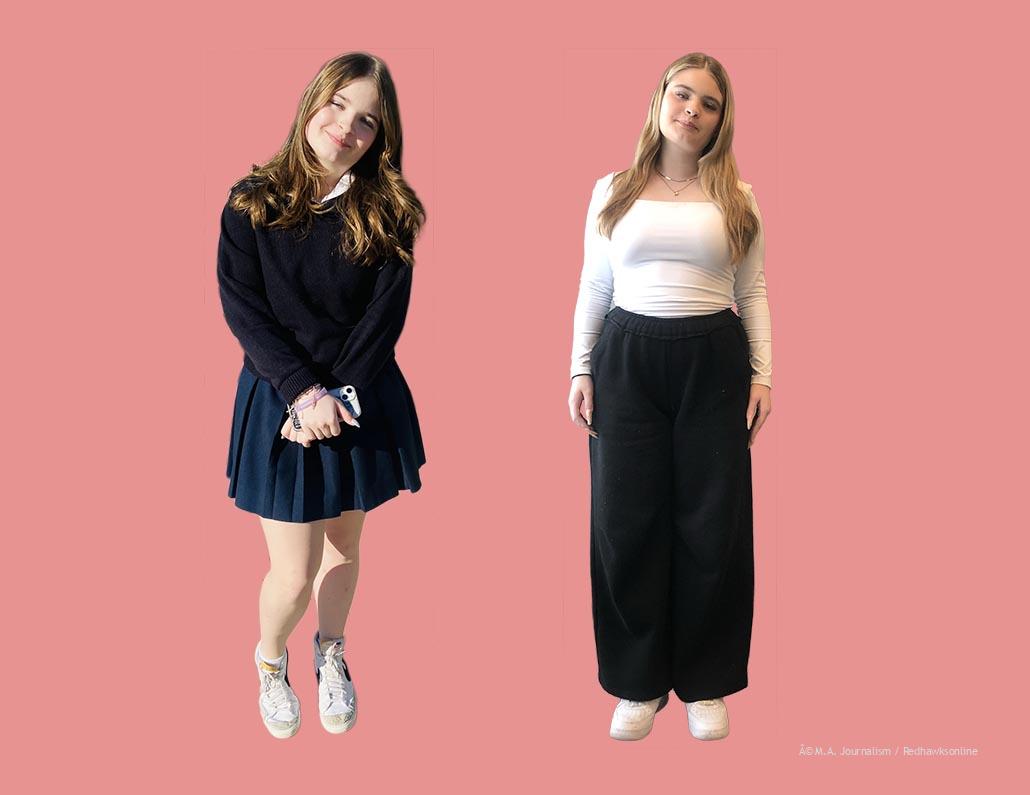

Do students’ school dress codes and attire actually affect their learning capabilities and behavior?
First-year Lindsey McDowell has formerly attended Visitation, an all-girls Catholic school with a certain required attire. Now at M.A., not only does McDowell have to adjust to making new friends, but she also has a big change in her everyday school attire.
At Visitation, McDowell experienced a lot less pressure in the mornings about what to wear
“I would say it definitely puts less pressure on students who get ready in the morning.”
But during school, her stress focused on her attire, meeting the standards.
“But I would say also, my school was very strict. So if anything was wrong (about your uniform), who would call you out, and sometimes she would call you out. It definitely happens sometimes because, you know, if you got dress-coded like three times in the same semester, or like trimesters in the trimester, and you got detention for like an hour.”
Now at Minnehaha Academy, a uniform-free school but with a dress code, Lindsey can say that wearing what she wants supports her learning a bit.
“If I get to wear a hoodie in school class, yeah, I guess, like, anxiety-wise, I don’t have to be stressed, I guess it helps my learning. But there are both positives and negatives.”
At M.A., a lot of people believe being uniform-free also helps with self-expression, which can play into their learning capabilities.
“As a community, I can say personally, as it gives me a lot more freedom. And I think for the students, it gives students a lot more creative expression, and they can actually be comfortable and like, you put your hood on as long as you’re not in chapel or, like, assembly. But like, you can just wear whatever, you get to be comfortable, but also express yourself.”
So now that brings us to ask what the purpose and the impact that school attire is bringing? Is it the uniform or the dress code?
Minnehaha Academy Principal Toby Castle believes that what the dress code does is to help students dress for what they’re about to do or engage in, but also express themselves in a learning environment.
“But do they bring unity in diversity so people can still express themselves while also feeling good? You know what’s old saying? ; Feel good, play good, do good, but while also maintaining a certain standard,” he said, “There are definitely ways in which people learn best when they’re comfortable, and they also feel that they can be creative and express themselves. So that’s really important.”
Castle then links how your school attire can affect your learning to his school life.
“There was a school down the road from us that was the only school that I was aware of that went uniform-free, and their academics were also excellent.”
Because many people believed that not having to worry about what exactly they should wear helps with their learning, Castle also agreed with this statement.
“Steve Jobs, the founder of Apple, only ever wore black. Just and, and and he did it, so he didn’t have to think about what he was gonna wear. So he did it to free up his cognitive load and to help with creativity.”
Most people assume that when you dress up formally, you are more likely to learn effectively. But according to multiple studies, the results are inconclusive or vary in many ways.
In a study of the effectiveness of school uniforms, no measurable difference was found in learning or requiring school uniforms. According to a 2022 study done at Ohio University, the College of Education and Human Ecology. The report, School uniforms don’t improve child behavior, study finds by Jeff Grabmeier, January 11, 2022.
https://ehe.osu.edu/news/listing/school-uniforms-don-t-improve-child-behavior-study-finds
In this story, an assistant professor of human sciences at the university explained that there wasn’t a measurable difference in behavior and learning overall, whether uniform or not. It goes on to discuss how students’ school attire serves as a means to express their true selves.
Additionally, another study at a university, conducted by Larry Wilder and Scott Key, such as Fresno Pacific University. The research suggests that a uniform can have a positive impact on academic success. But it only teaches students to dress based on context. They explain that the dress codes don’t help the learning process but just teach obedience to authority. Also, talking about how many educators believe that a dress code and attire also support a good educational environment. In this research, a principal of Dinuba High School said, “The dress code (attire) sets the tone for the atmosphere on your campus.”
https://news.fresno.edu/article/11/11/2007/pros-and-cons-school-dress-code
Along with that, in August of 2025, EducationWeek created a LinkedIn poll
asking about 700 people’s opinions on how they think dress codes/attire affect student behavior; 49% of people said dress codes improve focus, and 32% of people said it had no impact. And the remaining said other or creates distractions.
https://www.edweek.org/leadership/educators-just-cant-agree-about-student-dress-codes/2025/09
In January of 2025, Psychology Today completed a study called How what you wear can determine how you feel; psychology links our attire, attitude, and affect. In this research, they stated that the phrase ‘dressing for success’ can incorporate self-expression and esteem. Wearing ‘fancy’ clothes that make you feel confident can boost your working
Student services coordinator, Psychology & Personal Finance teacher, Julie Johnson said seeing this from a brain research and psychology perspective.
“I think that dress code and overall attire (of both students and adults) affect learning and behaviors.” She said, “Having a dress code to suit your institution and environment makes a lot of sense.”
Johnson referred to the well-known phrase “Dress for success”.
“We can dress in ways that set us up for success in our daily life – leading to greater self-confidence, feeling good, increased productivity, and working to do well in our work.”
She goes on to talk about how many studies have shown that dressing ‘nicer’ can build their self-esteem.
“Research has shown that generally people of all ages feel that dressing in a nicer manner (i.e., overly casual) can contribute to higher self-esteem (meaning, you feel better about yourself throughout the day), which in turn can lead to more productivity and greater likelihood to achieve your goals throughout the day (i.e., being able to focus, lock in, and get work done). On a personal level, we know that generally we feel better and more “put together” and effective when we take care with our attire, versus if we are looking and/or feeling like we just rolled out of bed and are dressed in an ultra casual manner, often our outlook and demeanor reacts accordingly. In a school setting, a way to strive for this feeling of higher self-esteem and greater productivity is to implement a dress code that encourages both students and adults to dress in a way that encourages these positive results.”
Having worked in the corporate business world before being a high school business teacher, Receiving 2 Master’s M.Ed. In Business and Marketing from the University of Minnesota and an MBA from North Park University, Julie Johnson has experienced having to ‘dress for success,’ and when she does, it gives her a boost in confidence in her work.
“I think the way I dressed at work during my few years in the business world before becoming a teacher helped me to both feel good and confident in my work, but I think it also helped me to be taken more seriously by my coworkers. I was a young female, newly out of college, without a lot of working world experience to help with my credibility as a professional. So, in addition to being a quick learner and hard worker, I think dressing the part for the success I wanted to achieve helped me put into perspective that I was meant to be in the roles I was in, and helped me to gain confidence and strive to be an effective leader in my profession.” She said. “I wore suits to work every day… so it made sense that I dressed the part to go along with that culture and atmosphere.”
Now at Minnehaha Academy, Johnson can see the change in her everyday attire
“Although I do not have to wear a suit to work every day now that I work in a school setting, the idea of dressing in a way that encourages success (for both the adults and the students) makes sense for being in a school that is striving for excellence on a daily basis.”
Johnson then links the idea of student dress codes and attire to self-expression to M.A.
“Some may not agree with the dress code as written, but I believe that thinking about it in this way helps to shed some light and perspective on the ‘whys’ of having a specific dress code. At Minnehaha, we do not currently require uniforms for students, which I think allows for a degree of uniqueness and personality in individual attire decisions” She said. “We are striving to provide a high-quality education that integrates faith and learning, and we want to help equip our students with confidence and skills to be leaders in our diverse world. So, our policies – dress code included – strive to support that greater mission toward excellence for our institution.”