
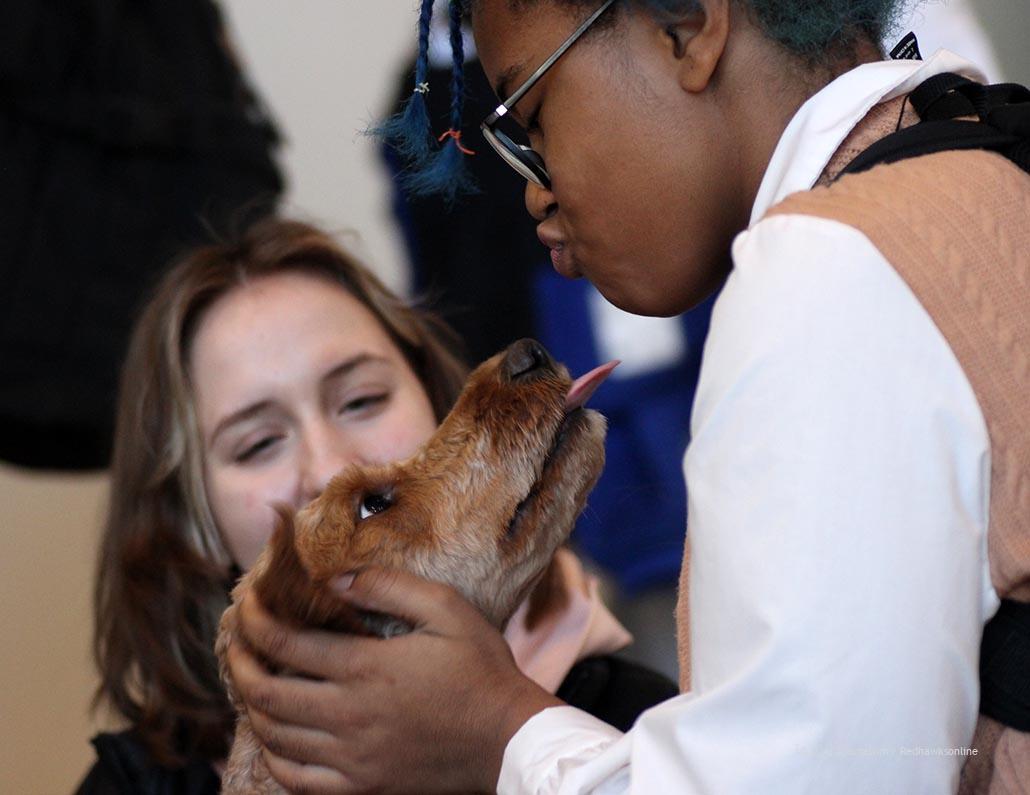

Science backs positive health impact of animals on humans
In the age of screens, depression, loneliness and less communication, sometimes people need something to hang out with that won’t judge, just love.
“Therapy dogs can provide unconditional re-
gard for people, allowing them to open up and
feel safe,” said Karolyn Shelstad, program man-
ager at Inner Guide Expeditions. She and her Si-
berian Husky, Tagg, are a certified therapy team
with the Alliance of Therapy Dogs.
Approximately 65 million households across
America have dogs, and most consider their dog
a part of their family. First year Corby Smith said
their family dog is like a best friend.
Dogs have been clinically proven to reduce
stress, anxiety and loneliness. Ninety-five per-
cent of pet owners rely on their pets for stress re-
lief, according to a Harvard study.
“Just petting a dog can have a calming effect
as long as the dog is safe and calm,” Shelstad
said. “We can tell them secrets they won’t dis-
close to others. They require us to engage with
them as a caregiver, which decreases loneliness.”
Caring for a dog creates a sense of purpose
and in return we get a companion that we can
rely on. The relationship between humans and
dogs is an easy cure to the loneliness that plagues
people worldwide.
“When Daisy enters the room, residents perk
up, hold out their hands, and smile,” said Pam
Canning, a therapy dog owner. “There is no ques-
tion that she has a very positive effect only by be-
ing there.”
Studies have shown that by simply petting a dog
your body releases oxytocin, a hormone that is es-
sential with connection, love and relationships.
Among Post-Traumatic Stress Disorder
(PTSD) patients, 84% of those who were paired
with dogs reported reduced symptoms, and 40%
were able to reduce medication, according to a
Johns Hopkins study.
Shelstad has seen dogs impact people of all
ages.
“My first therapy dog, Tagg, worked with a
young female client who was having a difficult
time talking to her dad about difficult things,”
said Shelstad. “Over about six months of thera-
py, she developed her ‘Tagg voice’ as she worked
with him on commands and tricks. She became
more confident and louder and was finally able to
share some ‘big emotions’ with her dad.”