
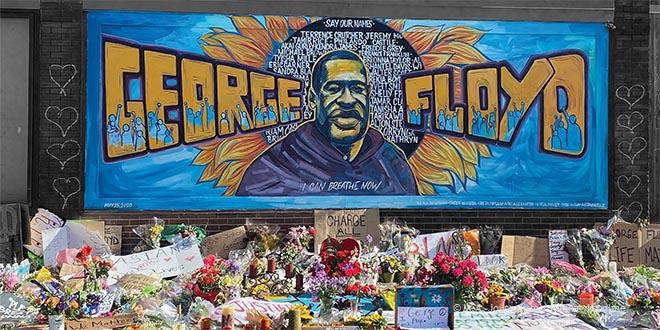

Trauma of Floyd’s murder still burdens the Black Community
On May 25, 2020, an innocent Black man named George Floyd was murdered in the hands of former Minneapolis police officer Derek Chauvin after he kneeled on Floyd’s neck for exactly 9 minutes and 29 seconds. Floyd’s death sparked extreme anger and shock in many people- especially the Black community.
“You can believe your eyes, that it’s a homicide, that it’s murder – this case is clearly about more than nine minutes and 29 seconds,” Jerry Blackwell, Floyd’s lawyer in the case, told jurors in Chauvin’s trial.
As a result of all the frustration and anger, many riots and protests sparked in the Minneapolis area.
“What happened to Floyd happens everyday in this country – in education, in health services and in every area of American life,” civil rights activist Al Sharpton said at George Floyd’s funeral. Stating that enough is enough, and it’s finally time for us to stand up for ourselves and demand justice. Sharpton added: “It’s time for us to stand up in George’s name and say, ‘Get your knee off our necks!”’
Around the time of Floyd’s murder many were widely aware of all the riots and protests that sparked, but few were aware of the mental health effect that the death of Floyd had on the Black community. Among African Americans it was extremely hard, not only because many had already been struggling with mental health due to COVID-19, which Black people and people of color are more at risk for, but also because of what seems to be a repetitive cycle of Black men and women being shot and killed by police officers.
Data shared by the Washington Post showed that in the week after the video of George Floyd’s murder became public, anxiety and depression percentages among African Americans went from 36% to 41%, affecting about 1.4 million more people.
“People are more aware of feelings of anxiety, general feelings of anxiety and anxiety connected to racism and microaggressions,” said Minnehaha Academy’s Diversity Director Paulita Toddhunter. “I’ve seen administration and adults in the community kind of step in as a way of helping students get through it.”
She worked with colleagues to respond to the crisis.
“You know, two years ago we noticed symptoms of anxiety and depression in students, and I wanted to provide a place to talk, a place to have a forum, a place to kind of get those feelings or whatever out,” Todhunter said. “So we worked with the counseling department and we actually brought in a Black therapist – some people really just wanted to talk to people of color about those issues.”
Students agreed that their fear and anxiety increased after Floyd’s murder.
“I wouldn’t say I found myself becoming depressed, but I definitely became more nervous and scared. Startled.” said senior Rolyns Aligbe. “I didn’t become anxious or depressed, but if I actually found myself in the situation of getting pulled over by a cop I would definitely be scared. Because that could happen to me. I could be killed.”
Junior Merrick Woods had a similar reaction.
“I wouldn’t say I saw myself being depressed, but I did have a little bit of anxiety,” Woods said. “Because I had these thoughts of fear. Every time I saw a police car I wondered, ‘will I be next?’ When Mr. Floyd died, I felt like it was a wake up call. I noticed more people actually trying to do something about it.”
“I didn’t find myself being depressed or having anxiety, but the whole thing was just scary for me,” said sophomore Liyu Lorato. “It was surreal. It was definitely hard to see someone who looks like me be killed for simply being Black.”
Despite the shock of Floyd’s murder, the violence didn’t stop.
- Approximately three weeks after the death of George Floyd, Rayshard Brooks, a 27-year-old Black man, was shot and killed by an Atlanta police officer.
- About two months after Brooks’s death, Jacob Blake, a 29-year-old Black man, was shot seven times in the back by a police officer in Kenosha, Wisconsin, and left paralyzed.
- On April 11, 2021, Minnesotan Daunte Wright, a 20-year-old Black man, was fatally shot during a traffic stop by former Brooklyn Center police officer Kim Potter, who claimed she thought she was reaching for her taser and not her gun.
- On February 2, 2022, Amir Locke, a 22-year-old Black man, was shot and killed after police officers busted into a downtown Minneapolis apartment while he was sleeping.
Looking at the bigger picture, between 2015 and 2020, 135 unarmed Black men and women were killed by police, and more than 75 percent of the police officers were white, according to a National Public Radio investigation.
The Black community has been forced to deal with many obstacles related to racism throughout history, but the trauma and grief experienced by African Americans of race-based crimes in recent years has been especially stressful.
According to data from CVS Health and Morning Consult, it has shown that anxiety and depression percentages have gone up by 11% in Black Americans since 2020.
There is still hope with the support of our community and of the ally’s around us things will start to change. As Nelson Mandela said, “We can change the world and make it a better place. It is in our hands to make a difference.”