
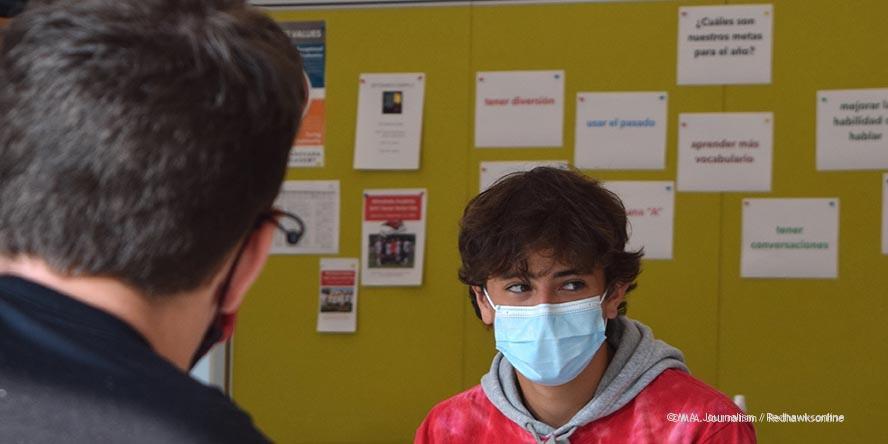

How communication is affected when you can see only half of someone’s face
Mask wearing has begun to be our new normal, at least for the moment. Everyone is trying to get in some sort of routine like they had before COVID-19 hit the world. So, with this new challenge, comes interacting with and meeting new people while wearing a mask.
This new normal can take a toll on our socialization and therefore create another problem, our perceptions of others. Creating relationships around school has been different this year. Upper School english teacher, Aleah Felton, is new to Minnehaha.
“For me, it’s been hard to recognize faces and names…especially when I can only see half of some-
body’s face,” said Felton. “I usually use a facial feature or a hair color but when half of my students have the same hair color, and or the same haircut, that’s harder
to get their names down.”
This has been the case for lots of people these days. Freshman Lily Ziniewicz has had experience with this too.
“It’s a lot harder to get to know people and make more friends because of the masks,” said Ziniewicz.
For freshmen, this is their first time being in high school. It most likely isn’t the way they would have anticipated last year. Being that they have no high school experience, wearing masks may have a different effect on them.
“I’ve kind of gotten to know some of the teachers, and I’ve liked the teachers, but then part of it is you don’t even know what half of their face looks like,” said Ziniewicz.
Some people have begun to notice different features about their peers or students.
“I’ll notice the way that somebody will generally wear their hair,” said Felton. “Or I’ll notice eyes or if they have freckles. That helped me get to know that person a little bit better. And that’ll usually help me recognize that person better.”
These other features are important nowadays because it is the only technique we have to actually identify someone when they are wearing a mask. This may be different for students and teachers that have known each other when wearing a mask wasn’t a part of their daily lives.
“I’ve definitely taken a lot more attention to people’s eyes more than I used to because that’s all we have to look at really,” said Ziniewicz.
Expressing emotions has been a factor in how people communicate for a long time. When the main source of expression is taken away, figuring out other ways is key. Science teacher, Carmella Whaley, has thought of a way to further express her emotions.
“Eyebrows are a big thing…and just trying to be even more facially animated,” said Whaley. “Just exaggerate all of your thoughts and emotions and movements.”
Finding other ways to ‘smile’ with your mask on helps with emotion expression.
“I find myself waving at people more instead of smiling or nodding,” said junior Tessa Bianchi. “Or when a teacher says something in class giving them a head nod acknowledgement instead of a smile.”
“I’ve been focusing on my eyes a lot,” said Ziniewicz. “You know when you see somebody you have to change your emotions with your eyes. Just opening them more or really squinting.”
Even though the world is going through challenging times, we have figured out ways to adapt. Some ideas, like wearing masks, may hinder our ability to meet new people, make friends, and express emotions, but we have found the positives.