

2020 might have been a terrible year, but some thought it was the final one
In the year 2020 there was a global pandemic, massive racial unrest across the nation, an economic crash, record breaking wildfires in western America and Australia, Kobe Bryant’s death, tensions rising with Iran almost leading to world war three, the third impeachment of an U.S. president in history, locusts swarm in East Africa, Chadwick Boseman’s death, murder hornets arriving in the United States, the death of long serving Justice Ruth Bader Ginsburg, and many more such events.
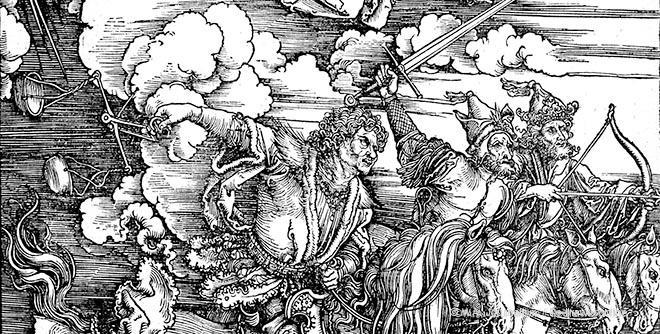
In the onslaught of bad tidings that is 2020, it is understandable to see the apocalypse come upon humanity. A Columbus, Ohio, church, called the End Time Apostolic Christian Holiness Church, thinks as such, and some supporters or opponents of Donald Trump, see him as either the chosen one, or Antichrist respectively, both of which would signify the end times. Should worries of the end times be heeded, or forgotten?
The Rev. Greg Ellis, who teaches Bible classes at Minnehaha, said that it is not uncommon for Christians to predict the apocalypse.
“Every generation since the time of Jesus expected Jesus to come back in their lifetime,” said Ellis. “So I think it is always pretty fair to say that we are living in the end times.”
Predictions of the world ending are a common occurrence in history. Seven years ago many thought the world was ending due to the Mayan calendar cutting off. Twenty years ago much of society thought that the Y2K glitch would end computers, bringing society with them. Various Christian clerics thought that the end of the world would occur at the turn of the millennium in 1,000 C.E. Events such as the fall of the Roman Empire, or the Black Death caused Europeans to believe the end of the world was happening.
In addition to the Bible, many religions involve a prophesied end of the world. Hinduism believes that Shiva, the destroyer, will end the world when the time is right; in Norse mythology Valhalla, a final battle between the giants and the Gods, will occur ending the world with only a few survivors; in Aztec mythology the world has ended four times already due to the suns, being remade each time with a new sun; and in Egyptian mythology if the snake Apophis, the embodiment of chaos, manages to eat Ra, the sun god, during Ra’s journey through the underworld, the world will end.
In short, there have been countless predictions of the end times, some of which, such as the infamous Heaven’s Gate cult prediction, were accompanied by mass suicide. Obviously none of these predictions came to pass.
Revelation, a New Testament biblical book written in the style of apocalyptic literature, tells of “the rapture,” an event in which the virtuous are taken up to heaven, while those remaining are to be left at the mercy of seven years of horrific calamities. Some of the “signs” or events that signify the coming apocalypse include plague, earthquakes and famine — events that have happened many times in history. For some Christians, a key “sign” of the apocalypse, according to their interpretation of Revelation, is the rebuilding of the Jewish temple in Jerusalem. However, some people don’t think the Revelation should be used as a way to predict the apocalypse at all.
Ellis said that it is hard to know what to worry about, and what to ignore.
“It seems like people fall into one of two categories, people who don’t care about Revelation, and those who care too much,” said Ellis. “It can be kind of hard to find that middle ground.”
David Hoffner, who also teaches religion classes at Minnehaha Academy, believes that trying to predict or prepare for a sudden apocalypse is misguided.
“I don’t think there is any biblical basis for the rapture,” Hoffner said. “I think that is something separate that gets shoehorned in.”
A somewhat recent concept in Evangelical circles is the idea of premillennialism, the idea that the rapture could happen at any time, discouraging efforts to improve world conditions. Instead this idea encourages trying to convert people to Christianity to save them as individuals. For example, in a movie called “The Thief In The Night,” a woman wakes up to her husband gone, but she is left behind on Earth. She was not prepared for the end.
Hoffner believes that fearing the end is not a good idea.
“That’s where you look at the Sermon on the Mount [where Jesus says] ‘tomorrow has enough worries of it own, you weren’t focused on today.'”