

I.S.S. team designs, builds annual microgravity experiment
A team of Minnehaha Academy students have been working with this vision in mind: It’s a crisp morning, and the launch pad is set and ready. Inside the resupply ship headed to the International Space Station is a piece of Minnehaha-made technology. It will activate once it enters space.
Its mission is to figure out what materials can help block radiation in space.
Minnehaha students designed the experiment in a year-long project. The team hopes that their research will be able to figure out what materials can help block radiation in space.
“Once you get away from Earth’s protective fields, radiation can become a big problem,” said Minnehaha science teacher Tim Swanson.
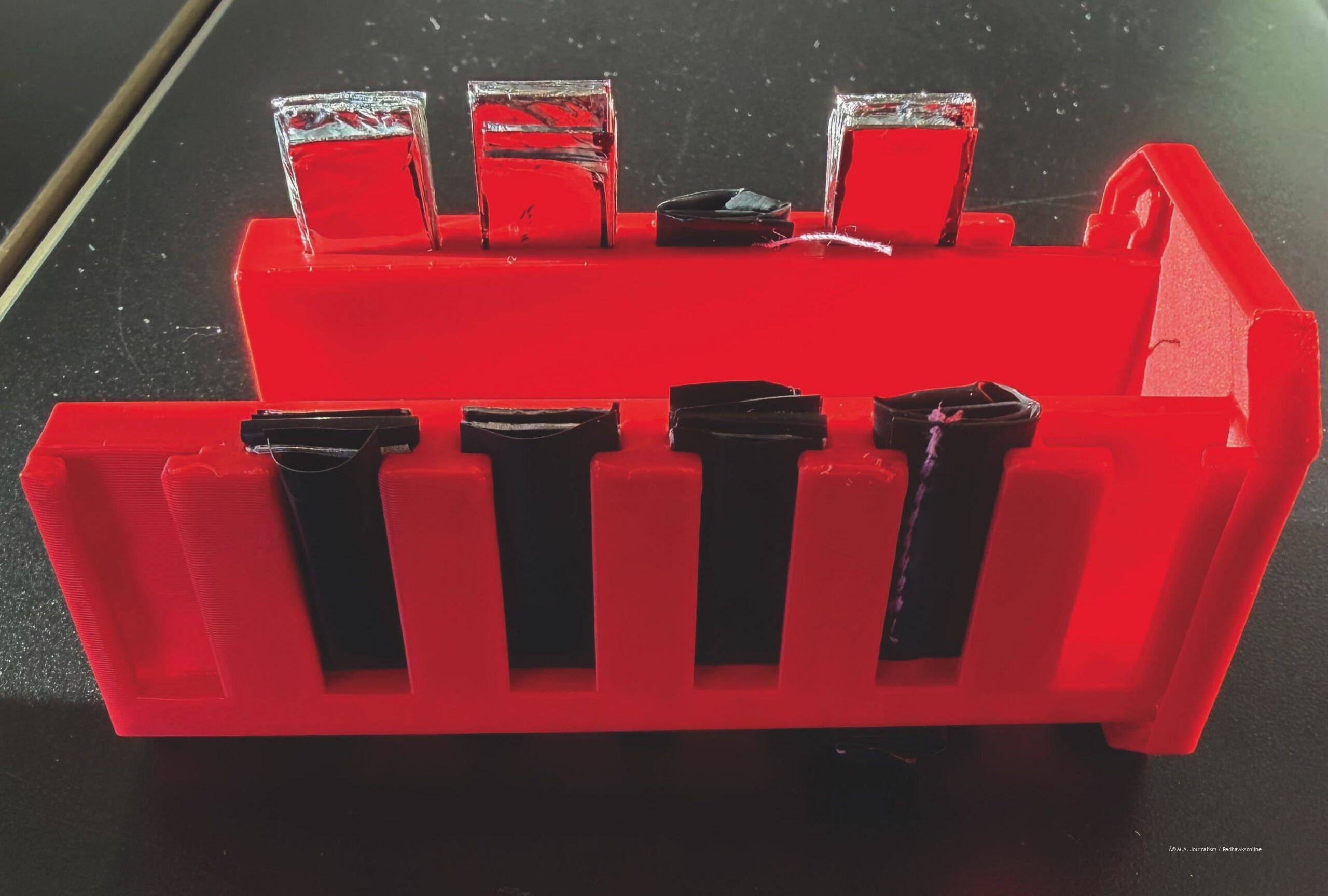
“They have something called radiochromic film, which can measure various amounts of radiation,” said Swanson.
They wrap the radiochromic film in certain materials that might be able to block radiation. Then they see which materials are successful at blocking radiation and which are not.
Swanson says the team’s mission is always decided by the students.
“They brainstorm during the summer and come up with ideas at the start of the year. The rocket carrying the project is supposed to launch late April or early May,” said Swanson.
A team of 12 worked on the project throughout the year. Swanson said that they “had a 3D design team, a science team that was in charge of the science, [a] mechanical team, they basically make it all fit in the little box, then a leadership team that kind of handles paperwork and keeps people going.”
Swanson and Christine Obert are the mentors of the project and say they try to let the students do the work.
There will be a change in the project around 2030.
“Early 2030, they’re supposed to bring it [The I.S.S.] down,” said Swanson.
But there is still a plan for the program to go on in the future.
When the I.S.S. Team took their annual trip to the American Society of Gravitational and Space Research conference, Swanson said they learned that “there are four commercial space stations that are in the later stages of planning that should go up before the ISS comes down.”
He said they would need one of their partners to contact one of the companies that is putting a space station into service and see if they would do the project.
Overall, Swanson said that “The students worked really hard on it, and I feel like this is going to be a really successful project.”
The project represents a chance for Minnehaha students to get a chance to use real scientific knowledge to test new questions about space travel and how radiation affects it.
Whether the project is used for practical use or is just a theory, the experience is invaluable.
On May 9, it was announced that the ISS experiment launch date has been pushed back to Dec. 1, 2026.
It is possible that an earlier launch may be possible, but for now the ISS team will have to wait patiently for their results.
