

State high-school league’s goals not supported by actions toward student media
The Minnesota State High School League (MSHSL) claims to be an organization that helps students. But with how the league runs activities, do they really help students, or do they harm them in the long run?
The league is best known for organizing varsity sports and adapted sports (setting rules, organizing conferences, classes and sections, and running state tournaments), but it covers a much broader range than just student athletes. Because of league-support, Minnesota high-school students can also letter and win state championships in robotics, debate, speech, one-act play, cheerleading, music and visual arts. In fact, the league describes its primary purpose as supporting education, not just athletics.
According to MSHSL’s website, “The Minnesota State High School League provides educational opportunities for students through interscholastic athletics and fine arts programs and provides leadership and support for member schools.”
But Minnehaha has seen the other side of the coin. In my opinion, as a journalism student who will graduate high school in a few days and become a journalism major at Toronto Metropolitan University, where I will train to become a professional sports reporter, I have major complaints about the way MSHSL has “supported” my education and our school’s attempt to cover its own athletes. I have come to believe that MSHSL prefers the professionals and money over students learning to develop into better journalists.
Denied access: Strikes 1 & 2
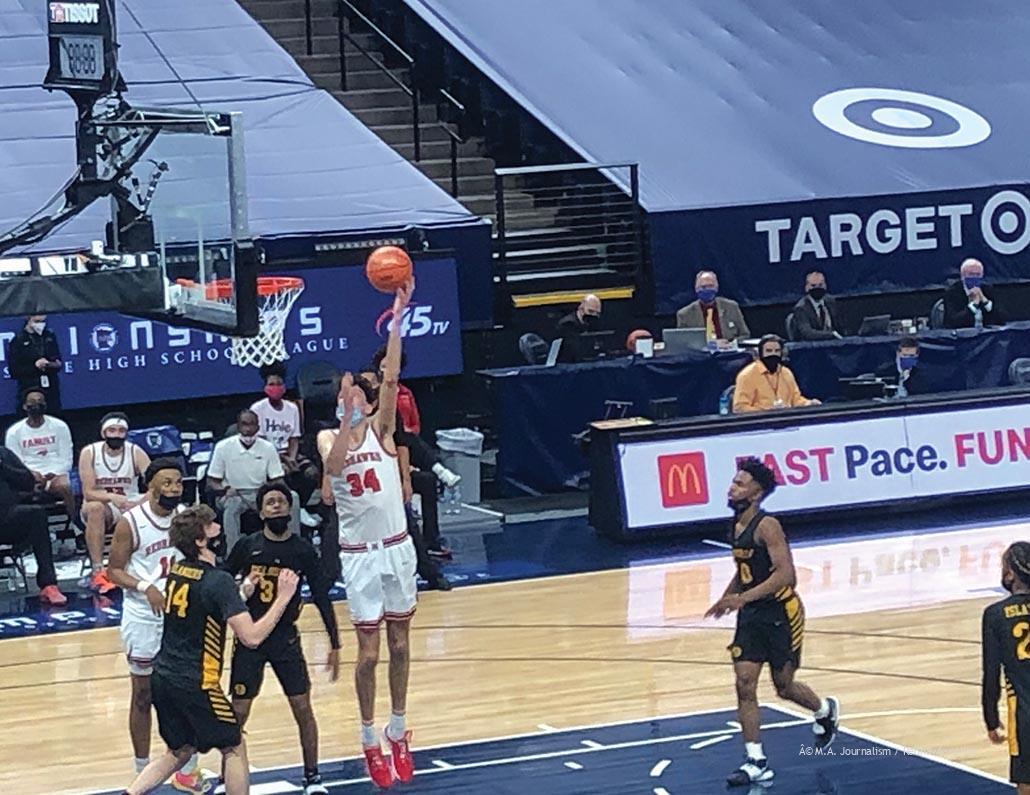
Recent issues started with the 2021 Minnesota State High School Basketball tournament. Minnehaha’s star player, Chet Holmgren, had a chance to secure his fourth and final state title as a senior with the Redhawks. By that time, he was the focus of national attention as the top recruit in his class and the winner of the 2021 Naismith Award as the nation’s top high-school basketball player. (In the video above, Holmgren hits a baseline jumper over IMG Academy senior Moussa Diabate, who has played in the NBA with the Los Angeles Clippers and Charlotte Hornets. Holmgren plays for the Oklahoma City Thunder. On Feb. 6, 2021, IMG gave Minnehaha Academy its only loss in a 20-1 season.)
The Class AAA state tournament, played at Target Center, was a highly anticipated event for Minnehaha journalists, eager to get the shot at capturing Holmgren’s final high school games. However, Minnehaha’s journalism students were denied media access to the game, which would allow them to take photos at court level using the school’s best cameras and lenses. They were told that they could take photos from their seats as spectators, but they knew that the Target Center policy was to deny spectators the right to bring cameras with large zoom lenses – the kind needed to capture quality images, even if they’re from bad angles.
MSHSL denied student-media passes, claiming that the ongoing pandemic made it unsafe to have too many people around the court. But MSHSL did give media passes to several professional photographers, who took the opportunity away from Minnehaha students to record a memorable chapter of their school’s history. The professional photos could be purchased by schools and families.
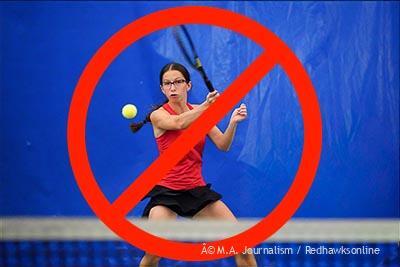
M.A. junior Chloe Alley won her third state tennis title, but M.A. photographers were told to stay home.
These difficulties have only mounted more in recent times.
During the 2025 girls state tennis tournament, Minnehaha was denied media passes to photograph junior Chloe Alley as she made a successful run for her 3rd Class A state championship – a doubles title in middle school, followed by back-to-back singles titles. MSHSL said schools could get media passes only for team competitions. Is Chloe less important because she competed as an individual?
Making things worse, the Antler yearbook staff were denied the right to download one free photo, taken by a professional, to use in the 2026 yearbook. MSHSL gave the reason as “per policy” without explanation. They said the photo could be purchased for use in the yearbook.
A high school newspaper and yearbook should not have to buy the rights to a photo when a student photographer is willing and more than capable of attending and taking a picture. Yet MSHSL barred student photographers from attending individual events for the purpose of student journalism.
Strike 3: My experience
I myself have also had problems with the league and its rules around state tournaments in the past. Just as many student-athletes hope to compete in their sport beyond high school, many student journalists want to pursue media careers. In a few months, I’ll move to Toronto for my college education and many opportunities to cover hockey as a journalist.
As a high-school student, I have been granted press credentials to cover the Minnesota Frost and Minnesota Wild for various organizations, including the Hockey News and the Hobey Baker Foundation. But getting a media pass from MSHSL is much more difficult. Professional photographers and reporters have told me that they, too, find it much easier to get access to NHL, PWHL, NFL, and Olympic competitions than Minnesota state tournaments. The recurring theme from all of them? How MSHSL limits media, especially students and small brands, favoring the high-paying, popular websites and newspapers.
During the 2025 Minnesota State Boys High School Hockey Tournament, I tried endlessly to get in as a photographer. I was consistently denied a press pass by the league due to their rules of only allowing student media for the participating schools. I was fortunate enough to get into the tournament to cover it for a professional organization, and the experience I gained, as well as the people I met, was unmatched. My four days spent at the tournament prepared me for media experiences in my future, as well as taught me many lessons about the work of a professional journalist.
In 2026, I was again denied a pass to cover the hockey tournament, and so was the organization I had worked for in 2025. MSHSL claims to support education, but its full ban of non-participant school media disadvantages students like me who want to prepare for bigger media roles. If passes are limited, student journalists could submit published stories and photo galleries to prove that they are ready for the opportunity. They shouldn’t have to rely on their sports team to make a state tournament to have an experience of a lifetime, gaining insight into professional media.
Rules impact coaches, too
But it’s not just the media side of things that Minnehaha has faced difficulty with.
Coaches like Track and Field head coach Kristofor Sauer have also faced support issues with the league, such as being forced to pay extra money to bring MSHSL-certified coaches to the annual state meet to support qualified athletes in their events. Track and field teams often have a large coaching staff, with assistant coaches focusing on specialized skills and events and some working specifically with boy or girl athletes. But MSHSL limits the number of coaching passes to state meets to the number that might be found for another sport.
“[Every year] we have to go through it,” said Sauer. “we buy all of the [passes] for our coaches, and then email out the QR codes, It’s pretty frustrating. Like why? What’s the rationale? You have somebody who’s on your coaching staff, they’ve done all of the MSHSL coaches’ clipboard, online modules, and stuff like that. They are a certified coach in your program. The school is paying them, and yet you’re gonna be like, ‘yeah, you don’t get to coach, we’re only gonna let two of your coaches in for free.’”
The limiting of passes given out at the events may be to limit outsiders, like parents or extra athletes, from gaining access to the events. But there are other solutions to keeping out unwanted parties while making sure athletes have the right number of coaches to support them.
“We’re not trying to bend the rules or anything,” Sauer said. “I’m sure that [their justification would be], ‘we don’t want parents getting coaches’ wristbands, [or] other athletes,’ or whatever the case would be. We’re not trying to game the system here. But we have enough coaches on our staff for the number of athletes that we have, so that everybody gets really well taken care of.”
The process becomes difficult and tedious, either leaving athletes unsupported or coaches paying the fees out of pocket.
“There were definitely times where I paid money out of my own pocket for our event-group coaches to be able to coach their athletes,” Sauer said, “because it was just too complicated to try to get the reimbursement [from school and work with MSHSL].”
Worthy of access
What happens when high-school students get access to high-profile events, such as state tournaments? Consider Minnehaha senior Ezra Victor, who has taken photos with a media pass at basketball and gymnastics tournaments since 9th grade – and has won national awards for sports photography every year, twice winning first place in the nation. Given a chance to learn, young media members can do excellent work.
Still, Victor hasn’t always had the best experience when photographing state tournaments.
“[I feel] they’re being very picky and selfish in the way that they’re prioritizing their own media and making sure that they get the best shots,” Victor said. “[They’re] limiting me in the way that I can get shots, because they’re putting me in, like, specific spots where I might not want to be in. As a photographer, you want to be able to move around to get different angles and get unique angles. And if you’re stuck in one point on the court, you only have one perspective, and if you want to tell a story with your photography, you need to be able to express yourself [with what] position [you’re] in.”
The MSHSL needs to rethink some of their decisions and reflect upon how they want to represent themselves before making the claim that they help students, when in reality, they leave student athletes, student media, and even coaches at a disadvantage.
