
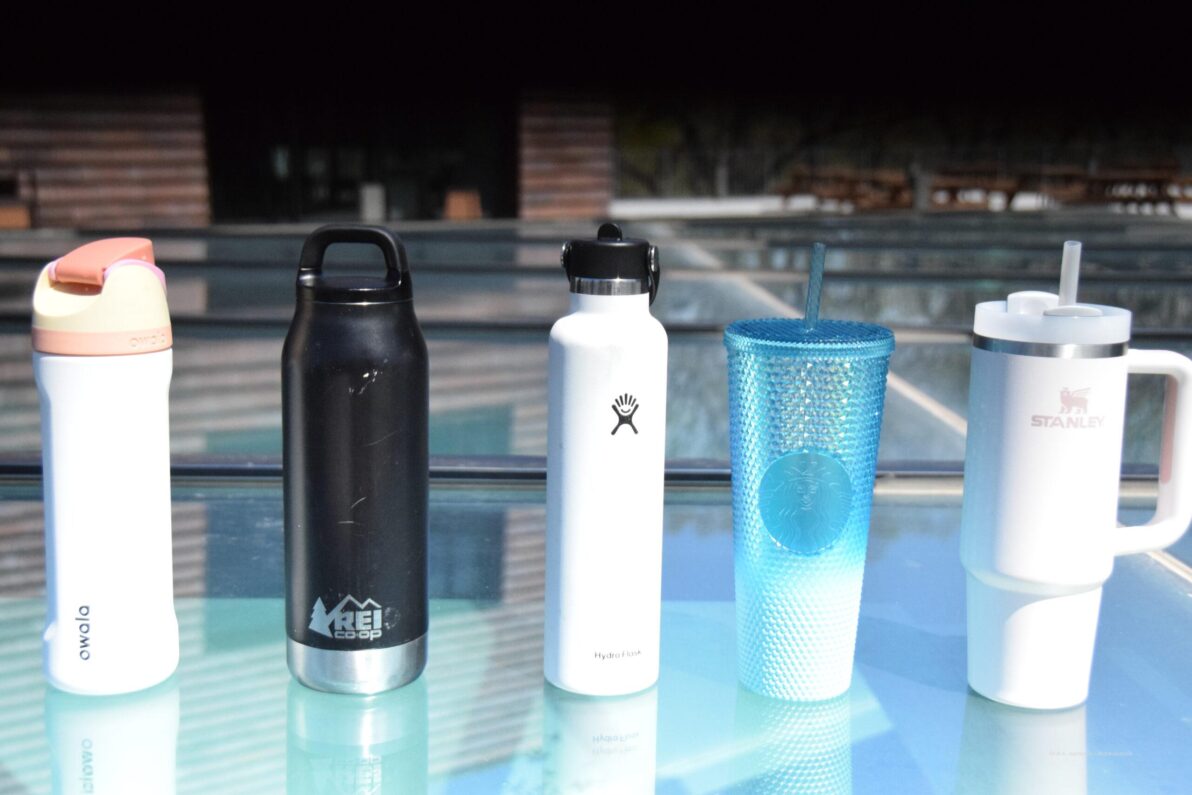

Cold or warm, red or blue, tall or short, thin or thick, sippy or straw: it’s up to you! Easily personalized, convenient, and good for your body, water bottles are a helpful essential for hydration.
Why should I drink water? You might be asking yourself this, deciding that it’s too hard to carry a water bottle all day and you’d rather just drink a glass of water when you get home. However, the effects of water expand farther than you might think.
Heidi Streed is the nurse at Minnehaha Academy highschool, who has advice and wisdom about hydration and health.
“The body is made up of 50 to 70% water,” said Streed. “That water is used to flush out what we eat, the toxins that build up in our body. It’s also used to help our joints and connective tissues have that fluid to move around.”
Everyone needs water: it’s a fact.
“All living things, from tiny cyanobacteria to giant blue whales, need water to survive,” according to the American Museum of Natural History. “Without water, life as we know it would not exist. And life exists wherever there is water.”
Matthew Johnson, Minnehaha highschool physical education and health class teacher has helpful insight on water’s effects on our bodies.
“Water is considered one of the six nutrients that we need along with protein, fat, carbohydrates, vitamins, minerals, and water,” said Johnson.
Dehydration and overhydration can both possibly have deadly effects.
Dehydration can cause tachycardia (higher heart rate), headaches, confusion, dizziness and feeling lightheaded.
“In general to try and prevent dehydration, you just want to make sure that your urine is light yellow in color,” said Streed. “That’s a really good indicator. If [your urine] is the color of Mountain Dew you are dehydrated and need to add more [water to your body].”
On the other hand, getting over-hydrated can be really dangerous. The kidneys can have trouble getting rid of the extra water: keeping everything balanced is the key.
When playing sports, though, drinking plain water might not be enough.
“And it’s important that it’s not only just water that it’s also water with electrolytes,” said Streed. “What happens is, when you sweat, you lose electrolytes, sodium, and potassium and things like that.”
That’s why sweat is salty: it contains a lot of sodium. Drinking sports drinks with electrolytes is important for athletes so they can regain those important nutrients.
Mrs. Cripe, anatomy and science teacher at Minnehaha Academy, leads a case study on a marathon runner, Kim, who dies from the lack of proper nutrients on her run. She explains that the important nutrients we need don’t all come in the water we drink. Adding electrolytes or salt tablets to our water can give us the nutrients we need. Kim only drank water before and during her race…leading to her untimely death.
All athletes need electrolytes as well as water to perform to the best of their ability, and stay on top of their game.
Senior Sienna Kath is a Nordic skier and cross-country runner.
“We have Gatorade at meets, but a big [help] are those packets with electrolytes that I put in water because I like those better than Gatorade,” said Kath.
One way to stay hydrated is carrying a water bottle with you throughout the day.
First-year Gretchen Rieke loves her water bottle.
“I have an Owala and I like that it has a straw and a sippy cup function,” Rieke said.
Water bottle personalizations can be fun as well. Research and Markets said that “reusable water bottles are now fashion statements,” which we’ve seen through the rise of Stanley Tumblers and countless other fun and unique reusable water bottle brands.
“I love ice water and I love straws, [my Otterbox water bottle] just works best for me,” said Streed. “Whatever works for you so that you’re able to take your fluids in is great.”
Water Bottles are an eco-conscious, convenient way to keep yourself hydrated.
“The global reusable water bottle market is expected to surpass USD 12 billion by 2028,” according to Research and Markets.