

In 1493, following Columbus’ arrival in the New World, the Doctrine of Discovery changed the scope of European involvement in the Americas for centuries. Signed by Pope Alexander VI, this Doctrine permitted Europeans, the Portuguese and Spanish in particular, to claim any land they “discovered” regardless of whether it was already occupied. But there was a catch: the colonizers had to act as missionaries and convert any occupants to Christianity.
“The missionaries or the priests would come and say, ‘here’s Jesus.’ Now you have to be like us,” said the Rev. TJ Smith, a Covenant pas-
tor in Anchorage, Alaska, and the president of the Indigenous Ministers Association.
As the New World began to change, so did the terminology. By the early 19th century, the Doctrine of Discovery had become known as Manifest Destiny in the United States. Americans quickly began to believe that it was their right to colonize the New World from “Sea to Shining Sea.” Native American Boarding Schools, such as the Carlisle School in Pennsylvania, opened by Henry Pratt in 1879, became a crucial part of this colonization.
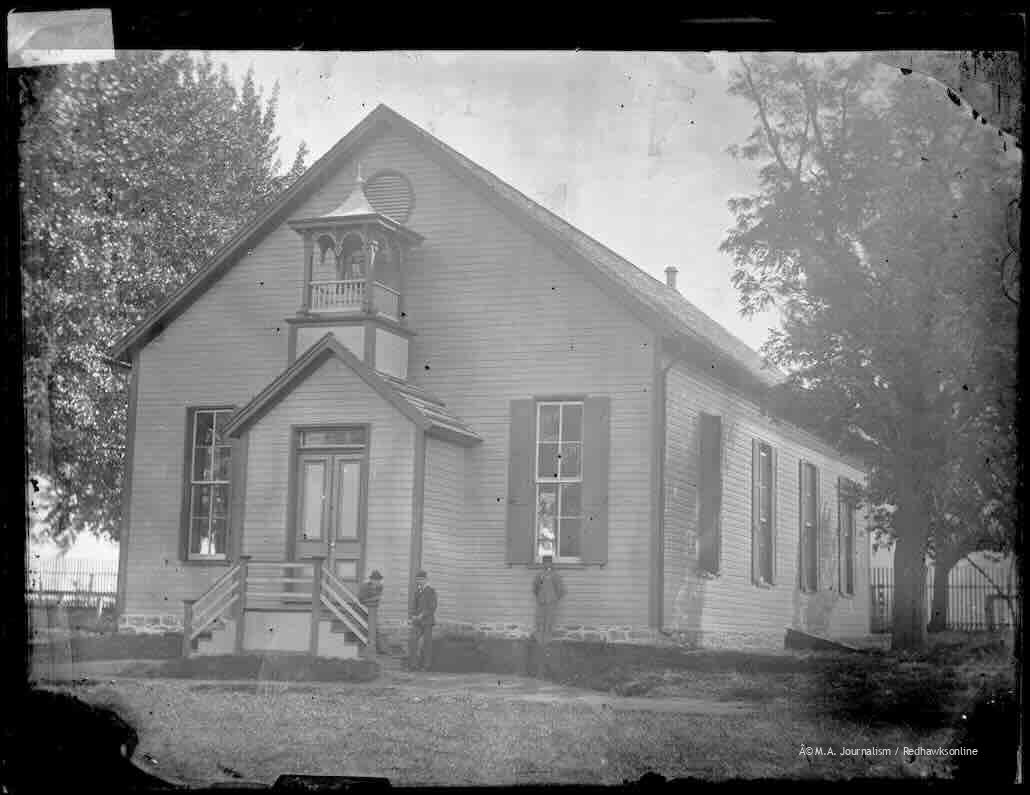
In 1887, a Native American Boarding School opened in Morris, Minnesota. This school, The Mission of Our Lady of the Sacred
Heart Indian Industrial School, was almost fully run by the Catholic Church. Similar schools were used as both tools by the U.S. government
for assimilation as well as Catholic missions. Of the over 400 Native American Boarding Schools, 87 were connected to the Catholic
Church, and many more were run by Protestant churches.
“Often, people blame the missionaries,” said Smith. “If you’re a missionary, you can’t go into the mission field until you understand language and culture.”
The Catholic Church was a huge instrument in the cultural genocide that occured because of the Boarding Schools. These schools
attempted to strip the students of their identity and culture. Often, for example, when students were first brought to the schools their heads
would be shaved.
“In my Lakota culture, when we cut our hair that means someone has died,” said Smith. “We offer it as part of our prayer for that person
who has walked on.”
The traumatic experiences did not end here. After being taken to the Boarding Schools, the students were forbidden to speak their Native language, and if they did they often faced beatings. Furthermore, in many cases they were banned from going home to visit their families.
“Many in the residential boarding schools were not allowed to go home in the summer,” said Smith.
“They had to work off their tuition. So they were basically slaves to the local farmers around. And then when they did go home two to three years later…they no longer could speak their language and their parents didn’t know English.”
Many Native languages are dying out because of these schools. In an effort to stop this, schools such as the Bdote Language Center in
Minneapolis are teaching students Native languages in an immersion environment. The Bdote Language Center currently offers the Dakota and Ojibwe languages. The University of Minnesota also offers Dakota and Ojibwe as languages.
In recent years, centuries after this damage occurred, Christian churches have begun to officially denounce the Doctrine of Discovery
and acknowledged the effects it had on First Nation peoples. According to NPR, churches such as Presbyterians, Lutherans, the United Church of Christ, United Methodists, the Episcopal Church and the Catholic Church have repudiated the Doctrine of Discovery as of 2023.
Smith has worked with the Covenant Church as they went through this process in 2021.
“That was a powerful moment,” said Smith. “We as a Covenant Church repudiated it.”