
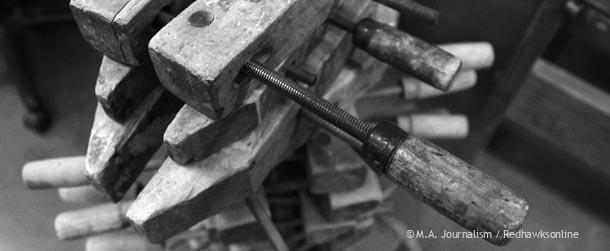

Curt Bjorlin on woodworking from Redhawksonline on Vimeo.
Declining student interest in applied education courses may result in the loss of life skills
As applied education classes throughout the United States decline, students may be missing out on important opportunities and life-skills.
Silence settles over the empty room like a heavy blanket muffling the sounds of the outside world.
The hard smell of spray paint mingles with the lightness of the sawdust hanging in the air as the faint hum of heaters reverberate throughout the room.
Cottonwood chunks are heaped in the corner and coarse wooden beams scatter the room leaving no surface uncovered.
Cabinets loom over their surroundings and the darkness in the cavernous room drinks up all but the few scraps of light the door allows passage.
Then, as if a breath held too long had finally been exhaled, a surge of footsteps echoes off the walls like the pounding of an incessant drum. Slowly, faintly, dwindling to a trickle as the minutes pass by and the silence settles again leaving the woodshop to settle back into its slow rhythm of slow days.
Where once students bustled, machines rumbled and voices flew through the room, the wood shop is now quiet.
Applied education classes, such as wood shop and home economics which are practical and applicable to daily life, have been a constant for past generations, but have become a rare appearance in the last decade as academic coursework has become more valued.
This shift has resulted the decline of these classes throughout thousands of schools across the country.
The loss of applied education classes has resulted not only in a few missing electives but has also created a society where “many young Americans now lack the domestic savvy that it takes to thrive,” as Ruth Graham states in her article “Bring back Home Ec!” in The Boston Globe. Without these skills being taught in schools many students never acquire them.
“So many kids right now have no clue what to do even with a screwdriver, a hammer or any home repairs,” said former woodshop, drafting and architecture teacher Curt Bjorlin who now works as Minnehaha’s building supervisor. “Kids are just not thinking about it as much.”
Bjorlin has taught at Minnehaha for 29 years, but stopped three years ago because of a decrease in student interest and course enrollment which led to the dissolution of wood shop classes at Minnehaha.
“Home ec. has been gone for probably 20 years, but woodshop has been gone more recently,” said vice principal Michael DiNardo. “In fact, even up to a couple of years ago we tried to offer it but the interest waned.”
As students enter high school, most are preoccupied with new teachers, friends and course requirements, so taking a practical class is not their highest priority.
However, according to former students, the value of applied education classes should not be overlooked despite how easily dismissible they may seem.
“I don’t think people see the value in classes like wood shop and home ec. until junior or senior year,” said senior and former wood shop student Gunnar Nelson. “[Woodshop] teaches you to respect the work that goes into wood products and it teaches you how to use tools and do something useful.”
Although the main goal of most people’s high school education is not to be able to make a clock or prepare a BBQ chicken rub, the opportunities presented by applied education classes are important and these classes present a nice break from the required academic courses that fill most students schedules.
“I liked being able to have a class that’s not necessarily school related but could help me in life,” said Nelson. “It is very applicable to daily life and you can go out and buy a $200 chair, or you can make one yourself.”