
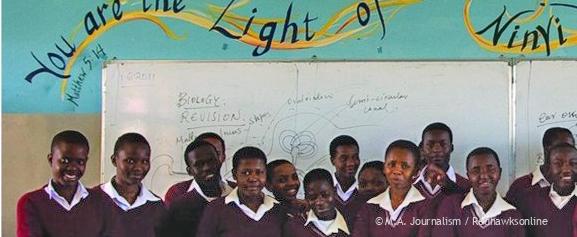

Peace House Africa Secondary School is taken over by church partner, school out of their control
Frances Hoekstra, Talon staff writer
“It’s a place where you have young people who otherwise would not have a chance being given a chance,” said CFE (formerly known as June Term) trip leader, International Project adviser and mathematics teacher Rich Enderton as he recalled his visit to Peace House Africa Secondary School (PHS) campus in Arusha, a major metropolis in northern Tanzania. Enderton remembers the trip as “pretty remarkable,” a statement the trip’s other attendees would be quick to agree with. Students were so moved by this trip that the Wetlands Project (a process that treats and finds ways to reuse waste water at PHS) was selected as Minnehaha’s 2011-2012 International Project. However, a recent turn of events at PHS has left Minnehaha students stunned for a much different reason.
Minnehaha became associated with Peace House Africa (PHA) before CFE began and before the school was built. Amy Swanson, Director of Cultural Immersion, received a phone call from a former Minnehaha parent around eight years ago informing her about the building of a new Evangelical Christian school in Tanzania. Swanson told the woman she would call her back when CFE got off the ground. It did, and Swanson visited PHA in 2009 to make sure it was a good fit for CFE. Enderton then led a CFE group there in June 2011, and the trip had a long-standing impact on the students who went along.
“The trip impressed upon me a close connection with the kids there at Peace House and we just grew really close,” said senior Amelia Schurke.
Students also came back with a deeper understanding of the typical issues that impoverished societies face, issues that are difficult for many Americans to relate to.
“I learned a lot about some of the very basic struggles that a lot of people in the world go through,” said senior Brady Ryan. “Struggles for basic food and having a chance to make themselves better that a lot of Americans don’t face.”
The news of the recent conflict at PHS was especially devastating to the students who had personal connections with kids at PHA. Since its establishment in 2001, more than 800 orphaned and vulnerable children have been educated at PHS. On Nov. 26, 2011 PHS was taken over by their church partner, the Evangelical Lutheran Church of Tanzania- North Central Diocese (ELCT-NCD).
PHA partnered with the ELCT-NCD in 2004 because of their non-profit status (which PHA didn’t have at the time) that allowed them to apply for certain tax reductions, but they didn’t foresee the negative repercussions of the partnership.
“Very early in the relationship we caught them writing unauthorized checks against the PHA account,” said PHA’s Director of Operations Dan Grewe. “We also caught them diverting cement from the PHS construction project to a hotel that the NCD was building.”
PHA reached out to the ELCT-NCD in Sep. 2011 for help creating a plan that would reduce operating costs for the school. Part of PHA’s proposal was to negotiate how to jointly run the school (which would be more cost-effective), but ELCT-NCD officials didn’t bother with discussion; instead the ELCT-NCD forced their way onto campus armed with assault rifles (during a scheduled school break) and seized the school, forcing out staff members.
Officials of PHA have been trying to negotiate a resolution with the ELCT-NCD to regain possession of the school, but so far have been unsuccessful. Students were able to safely return to campus on Jan. 14, 2012.
Unfortunately NCD schools are ranked in the bottom third of all secondary schools in Tanzania (as opposed to PHA, which is ranked seventh out of 320 schools in Tanzania’s northern region).
“It’s really disheartening to see that an entity within the community that you would tend to trust would be taking advantage of both the financial situation and their position of power to wield some degree of control,” said Swanson. “What’s so disheartening to me isn’t that they went to local authorities and got them involved but that the [ELCT-NCD] doesn’t understand the value of what is being done on that campus. They clearly don’t comprehend the value of that education, the campus community and the future of those students and their country.”
As of Feb. 12, 2012 Minnehaha students have raised $6,313 for the Wetlands Project, which is currently on hold until further information on the state of PHA is acquired.
The money already raised for the project is being held in account at the Peace House Africa office here in Minnesota.
While Minnehaha cannot directly affect the events taking place in Arusha, Tanzania, PHA officials are asking for the support of the community as they “send a clear message that a collective spirit of compassion and hope will prevail over corruption and justice,” according to an email sent by Grewe.
“I think right now it’s a bit of a waiting game,” said Enderton.
Though change in Tanzania is not necessarily in Minnehaha’s power, PHA officials are working nonstop to ensure that justice will prevail. Their website gives an account of the events at PHA over the past few months, and the homepage boldly displays the African proverb “When the drumbeat changes, so must the dance.”
When it comes to educating orphaned and vulnerable children, Peace House Africa is changing its dance, but not its mission in the face of adversity.