

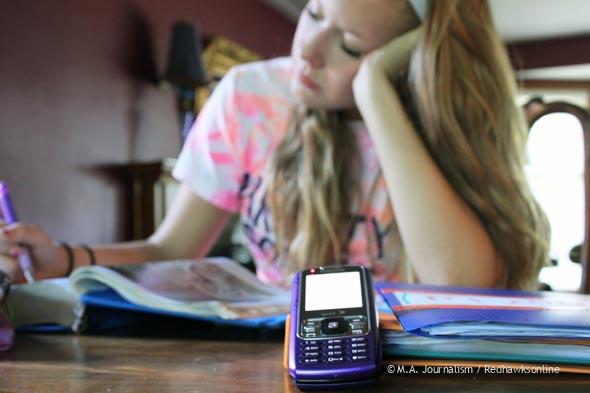
For many students, texting has replaced actual conversation all too often.
Have you ever misinterpreted a text message you’ve received? Or maybe a text you sent was misunderstood by the person who received it.
As texting grows in popularity, actual face-to-face conversation has become almost obsolete for high school and college students. Our generation is relying on texting to have our most meaningful conversations.
What we need to realize is that you can send all the smiley faces and sad faces you want, but an emoticon can’t replace the real grins, smirks, frowns and grimaces you make or witness with your own eyes. The role of texting has grown exponentially in the last few years, with one in three teens sending more than 100 text messages a day, according to a recent study by the Pew Research Center Internet & American Life Project.
“Texting is a great way to take a break from homework and to catch up with your friends,” said senior Tony Mrozek. “It’s way faster and easier then talking on the phone, because you can mulititask when you’re texting easier than when you’re on the phone.”
While texting is useful for easy, fast communication, it has its flaws. You can connect, but you can’t clearly communicate how you’re feeling. Because teens are dependent on texting their friends, they lose the effect of a face-to-face interaction.
“I think that over texts I’m always more sarcastic and I exaggerate things. People know that I’m just joking and I’ll do a little smiley face just to make sure,” said sophomore Bryanna Williamson.
Most teens would agree that texting is the new talking. But when texting is substituted for an actual conversation, you lose a certain amount of understanding and connection to what the person is saying because you’re reading it off a screen rather than hearing them speak the words. For instance, reading someone’s face and reaction to find what you should and shouldn’t say is a feature lacking in text messaging.
Another effect of texting is the constant distraction from academics. Teens are doing their homework with their cell phones right next to them, buzzing every two minutes with a new text message in need of a reply.
“It’s definitely distracting because it vibrates and I think, oh I have a new text, then I read it and even if I don’t respond right away, I have to think about what to say so I’m not focusing on my homework,” said sophomore Natalie Welsch.
“It’s distracting because it makes me want to talk to my friends when I know I should be focusing on my homework,” said sophomore Elise Marcotte.
Many teens are facing that same problem. While it may not seem like a big deal to take a five second break from your studies, it may take you longer to transition from replying to the text to actually focusing on your homework again. When you’re receiving a new text every two minutes, this may take a toll on your ability to focus on your school work.
“Depending on the person, texting may not be the most distracting thing but it certainly contributes to the distraction,” said Richard Pluntz. “The whole instant thing is the distraction because if you’re halfway through an important math problem and you’ve got a text it could break your train of thought.”
After thinking about it in depth, I’ve come to the conclusion that although I’m not going to give up texting for good, I’m going to shut the phone off every once in a while, especially when I’m working on homework, so that I’m not distracted by a new text every two minutes.
Although texting may be easier and faster than talking on the phone or face-to-face, sometimes turning the phone off and interacting with the physical world around you is better. Maybe even consider just relaxing or doing nothing because that has the potential to be more beneficial than constantly being in-touch with anyone who makes the phone buzz.