
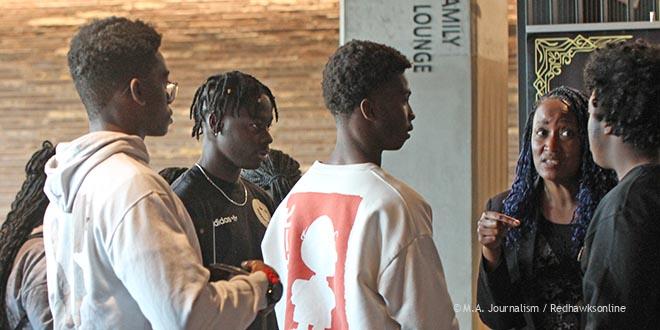

HBCU fair at M.A. demonstrates interest in unique college option
We all know about the famous hate crime surrounding George Floyd, who was viciously killed by Derek Chauvin in May 2020, and of similar crimes involving Breonna Taylor, Ahmed Arbery and many others (see “Trauma of Floyd’s murder still burdens the Black community”).
“Mr. Floyd died because his heart was too big,” said Jerry Wayne Blackwell, prosecutor in the case. “You heard that testimony. And now you’ve seen all this evidence, you know the truth. And the truth of the matter is, the reason George Floyd is dead is because Mr. Chauvin’s heart was too small.”
The sad thing is George Floyd wasn’t the end of the continuous cycle of hate crimes to Black people and people of color. Many people don’t know that Ahmad Arbery, Breonna Taylor and George Floyd were killed within weeks of each other. They were also young Black people who were mostly killed by police.
We also know of the rise in activism following these murders. This movement was a wake up call for many Black youth. Many teenagers decided that they needed to start attending Historically Black Colleges and Universities (HBCUs) to be successful, feel safe and welcomed.
HBCU college applications increased by 9% in 2020, following Floyd’s death, according to the National Center for Education Statistics.
HBCUs are colleges where the main population of students are Black or students of color; however, students of all races and backgrounds can and do attend. HBCUs were founded for Black people beginning in the late 1800s because Black people could not attend Primarily White Institutions (PWIs).
When Black youth attend HBCUs they are more likely to graduate, feel connected and supported while in school and succeed in life. It sets them up for success. In fact, according to United Negro College Fund (UNCF), HBCUs produce about 20% of Black college graduates even though HBCUs only represent 3% of all colleges and universities.
“It was like yeah, I’ve got to be around my own people,” Randolph Smith, a student at Morgan State University in Baltimore, told the Washington Post.
Students who have started paying attention to HBCUs notice many positive factors to draw their interest.
“It’s just like walking around you see all aspects of Black growth, Black prosperity,” Nia Martin, a college student at North Carolina Central, told ABC11 News in Raleigh, NC.
Minnehaha Academy recently had its first annual HBCU Fair and Alumni Panel. Many students offered feedback about it.
“I thought the fair was really good,” junior Merrick Woods said. “It was really fun, and I learned more information about HBCUs that I didn’t know before.”
Woods said he may like to attend an HBCU in the future.
“I thought it was good,” said Del Johnson, a junior at Wayzata High School. “It was a great experience and I’d like to attend an HBCU.”
Many parents attended the event to support their sons and daughters.
“My dad encouraged me to attend the fair, and I’m really glad that I did,” said Minnehaha sophomore Grazina Troup. “I really enjoyed the fair, and I would like to attend a HBCU in the future and run track at one.”
Many students attending college fair agreed that George Floyd’s murder and the social activism that followed was an important factor in their interest in HBCUs.