
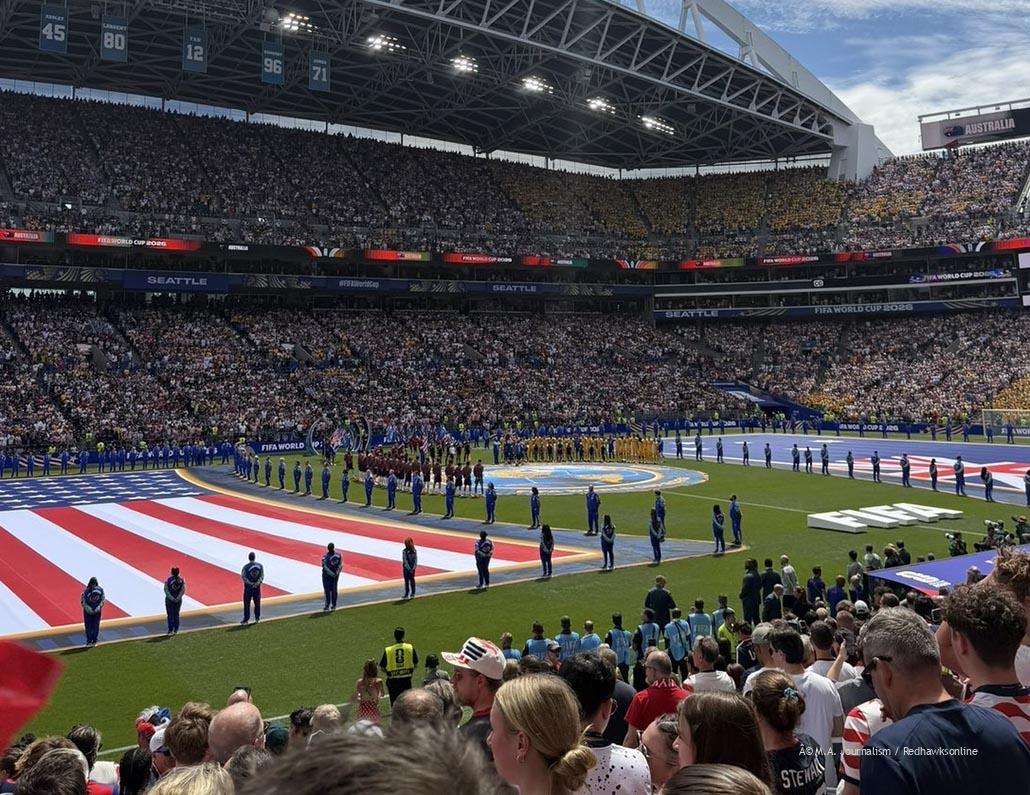

Bringing the world together by celebrating global cultures
“Flags flying every color of the world; cheers of astonishment, anger, and ecstasy echoing through stadiums, houses, and sports bars alike; strangers hugging strangers to share in the euphoria of a win for their country… Behold: the FIFA World Cup.
The summer of 2026 host-ed the most-watched event on Earth, a global soccer tournament—or football tournament, to most of the world—that featured 48 nations competing for the 18-karat gold tro-phy and $51 million in prize money. This year, a few match-es were held in Canada and Mexico, but the large majority of games were played right at home in the United States. Be-cause of this, America opened its doors to welcome a variety of cultures, peoples, and heart-warming stories that linked our world and country together.
Lucy Lutgen, a varsity soccer player and avid follower of the sport, noticed new trends around foreign reactions to America.
“With the World Cup being in the United States, a lot of people were a little wary,” said Lutgen. “With all the international arrests stemming from the U.S. and conflicts in the last year or so.”
These observations were correct. Positive views of America plummeted from the start” “of 2024 to 2025. According to the Pew Research Center, over six out of ten adults in neigh-boring Mexico and Canada now view the United States unfavorably, as well as a large majority in France, Spain, Germany, the Netherlands, Australia, Turkey, and elsewhere.
However, Lutgen realized that the World Cup could be a chance to change these statistics.
“The world [got] to see how America actually is, and how Americans actually are. Inter-national travelers online were posting about Walmart, going to Costco and Target, thinking, ‘Oh my gosh, yellow school buses are real!’ and seeing what [American culture] is actually like,” said Lutgen.
Lutgen believes this summer was a turning point for our country.
“It was really uplifting to see all these international people from places outside of the US acknowledging and appreciating what America has to offer, instead of the negative things that are always being shown on the world stage,” she said.
In mid-June, Boston host-ed Scotland’s Group C opening matches. According to the Boston Globe, “As many as 50,000 Scots… descended on Boston.” The city was overrun with Scottish fans, dubbed the “Tartan Army”, who were dressed in traditional kilts, belting out songs in the streets, blowing bagpipes, and decorating statues with traffic cones in the loving Scottish fashion. Boston experienced up to a 179% spike in local bar spending as the Scots drank them dry. Establishments were completely drained of ales and Guinesses, and ESPN recorded fans’ beer intake as more than four times the amount native Bostonians usually drink around the Fourth of July. The “peaceful invasion,” in the words of Boston Mayor Michelle Wu, was widely welcomed by locals, and “New Scotland,” as they called it, served as a symbol of inter-national camaraderie.
Similarly to Massachusetts welcoming the Tartan Army, Kansas also invited a foreign culture into one of their cities.
The Algerian national team selected Rock Chalk Park in Lawrence, Kansas to be their training camp for the tournament. Upon the team’s arrival, the University of Kansas’ marching band played the Algerian national anthem, and city officials, businesses, and locals decorated the small college town with Algerian flags, banners, and colors. Lawrence res-idents took the opportunity to embrace and learn about this new culture, participating in Arabic and French classes and organizing cultural community events. During their match against Austria, Algerian fans held up a large “Thank You Lawrence” poster to express gratitude for Kansas’ deliberate hospitality and to share in the experience of intermingling traditions.
Sophomore Nora Rieke spent her summer in Sweden at the Gothia Cup, the largest youth soccer tournament in the world comprising over 1,000 teams. Because of this, she gained a unique and inter-national understanding of the World Cup.
“We stayed at a school with teams from all over the world,” said Rieke. “Every time there was a World Cup game… all the teams would come together and watch. It was so cool to be with teams from other countries, cheering and talking with them.”
When thinking about her favorite memories, Rieke recalled a certain team’s patriotism.
“When Spain was playing,” she said, “all the Spanish players [in the tournament] would be sitting in the front row, wearing their Spanish jerseys, cheering loudly, showing pride for their country. And we would be cheering with them.”
Soccer is an opportunity to bring people together, she said. In that regard, Rieke is spot on. The World Cup inspired global pride and profound international camaraderie. Whether it was cheering for an underdog, experiencing a global culture authentically, or celebrating the traditions of a foreign country, the simple idea of kicking a ball around a field brought the world together.”