
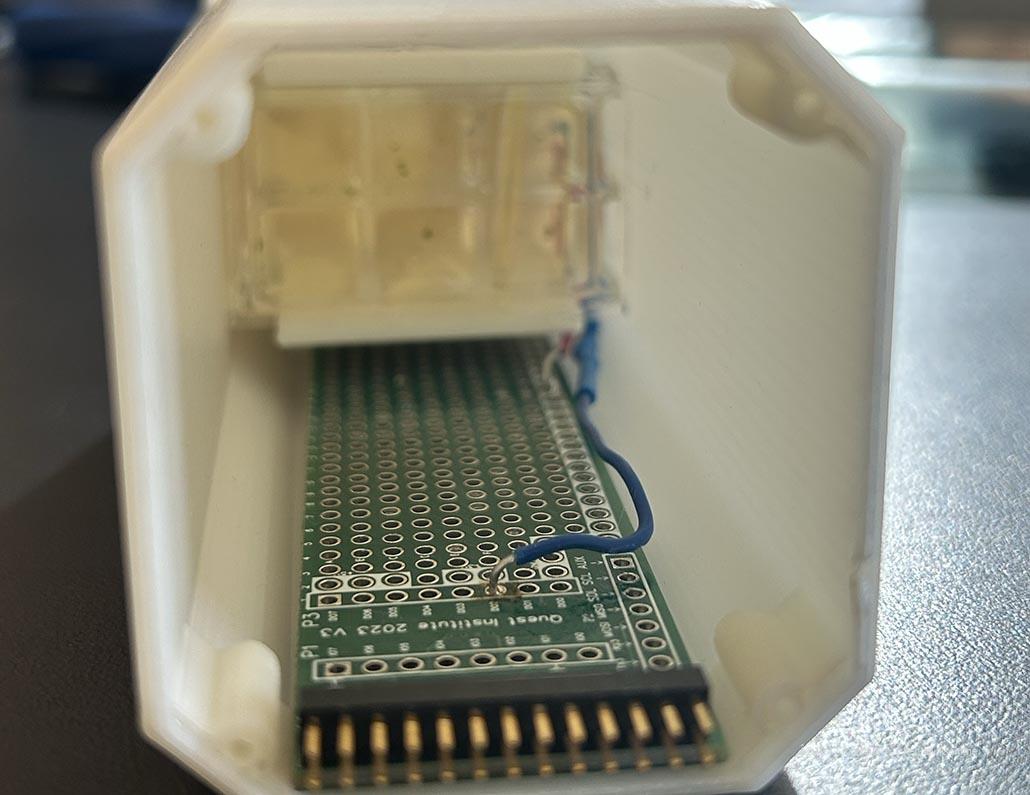

This school year the International Space Station (ISS) project class decided to send microalgae into space. You might wonder why. “When the algae get under stressed conditions on Earth, they produce an antioxidant,” said Tim Swanson, teacher of the class. “Algae also is really good, for it does things like convert [carbon dioxide] into oxygen. You can use it as a nutritional supplement. So there’s lots of good reasons for algae to be able to grow in space, and we’re focusing specifically on its production of this antioxidant. It’s called astaxanthin.”
The group’s original idea was to send two types of microalgae – haematococcus pluvialis (H-pluvialis) and clama dominos nivalis (C-nivalis) – to the ISS to test its growth in zero gravity. But after getting better initial test results from H-pluvialis, they decided just to send it instead. The project is testing if microgravity is a stressed condition that will cause the algae to produce astaxanthin. This would create a space-efficient farmable food source. The team was allowed to create an experiment that would fit in a small rectangular box just big enough to fit in a pocket, but that didn’t stop them.
The team started planning their project over the summer using a scoring system, which took into account whether the proposal was appropriate to test in a microgravity environment, whether a high school class could create it, and whether it could be done given the size limitations.
“For the class over the summer, we’re all told to pick an idea and research that, and there’s a document that everybody fills out, and they just put their idea in,” said senior Max Anderson, team leader of the ISS project this year. “And then when we get together at the beginning of the school year.” Student contributions drive the project forward. “We come across two or three projects that have scored the highest, and we know would work for all of the criteria,” Anderson said. “And then we split up and do a deeper dive. And then we just ended up with this one because it seemed it was adjacent to what we did last year, which was fungi, kind of in that realm of biology and growing, and so that’s what we ended up with.”
While the project was focused on algae and biological growth, students experienced personal growth in areas such as leadership and coordination. “I was in a leader role,” Anderson said. “I learned a lot about how to organize a group of people. And just like figuring out how to manage a group of people and getting people to cooperate.”
The project is scheduled to launch on June 7. The launch will take place at Cape Canaveral launch pad SLC-40 in Florida. The experiment will ride to the space station in a Northrop Grumman NG-22 Cygnus capsule propelled by a SpaceX Falcon 9 rocket. The team will monitor results remotely and after its return.