

A 17-year-old boy lays face down in a pool, playing the piano with his hands on the deck. A man stands over him giving directions.
“Raise your right hand,” he says.The boy raises his hand with no delay. His coach hovers over him carefully observing his movements. Safety is of the utmost importance. Especially in this last one-minute stretch.
Filip Markus, an exchange student and senior at Minnehaha Academy, lays in the pool thinking about nothing. He hasn’t taken a breath in three minutes. This exercise, called a static-breath hold, helps free divers practice remaining calm and focused on their body. Markus’ breath holding record, about four minutes and ten seconds, didn’t happen comfortably.
“It starts to become a real fight because [you start] getting contractions. Your diaphragm contracts as your body’s reflexes basically breathe in,” said Markus. “For me the four-minute mark, it’s just like you don’t think about anything. You’re just hanging in there.”
COMPETITION
For the past two years, Filip has spent two nights a week doing static-breath holds, active-breath holds and technique practice. The other nights are spent doing dryland training and stretching.
Free diving, a sport similar to scuba diving, requires huge amounts of dedication, bravery, and training. As opposed to scuba diving, where divers wear masks and oxygen tanks that allow them to breathe while underwater, free divers must hold their breath during both their descent and ascent from the water. The divers need the ability to hold their breath for minutes at a time in order to stay safe and alert while diving tens of meters underwater.
Compared to most other sports, the free diving community’s growth only began recently. In fact, Filip is the youngest on his team by more than a decade. Possible freediving locations need to be cleared by professional free divers before use, and for Filip, who lives in an Austrian suburb of Bratislava, Slovakia, in central Europe, this means a lot of travel.
The dangers of the sport include blacking out and, in extreme cases, death. The most important rule of the sport: Never dive alone.
“I cannot compete yet,” said Markus. “They don’t allow people who are under eighteen into competitions because of safety reasons…it’s a dangerous sport, and it shouldn’t be attempted without proper training and instructions.
TRAVEL
“When you’re in the ocean or in the sea, it’s really just an awesome feeling that you have to get used to,” said Markus. “It’s completely
silent…it’s one of my favorite things. The silence of it.”
Family vacations allow Filip to practice free diving in the sea. In fact these trips launched his desire to take free diving lessons. “As a family we used to go to Croatia, to the sea a lot and when we were by the sea we just used to snorkel a lot,” Said Markus. “It kind of came naturally to dive down and snorkel. And then at some point I realized ‘oh, this is a sport, I can do this.’”
DIVING IN EGYPT
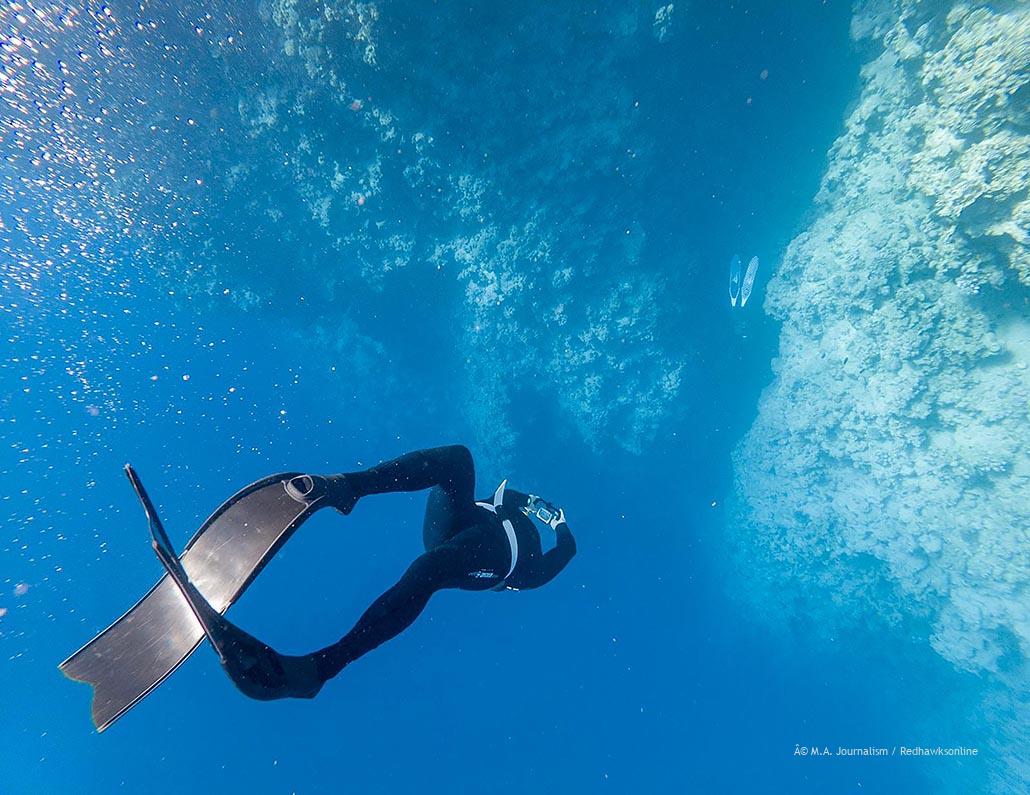
Over Easter break last year, he traveled to Dahab, Egypt, to practice freediving at one of professional freedivers’ favorite locations. For six days, he and fellow divers attended safety briefings, practiced their static breath holding as well as their free dives.
“It was the first time I went down like twenty-six meters,” said Markus.
Filip’s whole family enjoys water sports. His younger sisters swim for the Slovak Artistic Swimming National Team. Filip’s father has wanted to take freediving lessons with him but hasn’t been able to yet. His whole family enjoys snorkeling, especially in Croatia.
“As you become a better freediver, it gives you the freedom to go deeper and to see marine life and all the beautiful things,” said Filip
UP FOR AIR
Filip has reached the final stretch of his static breath hold. He devotes his whole concentration to remaining calm and holding his breath for just a little longer. The diaphragm contractions get worse. His coach continues to speak and asks him to
lift up his left hand. He delays for a moment, and then finally raises it.
“Ok, come out, come out,” his coach tells him.
Filip finally comes up for air. Sometimes his coach has to drag him out [Not because he’s unconscious, but because he wants to keep going beyond his coach’s limit.]
“[You] come out and then you breathe a few times,” said Markus. “And you’re fine!”