
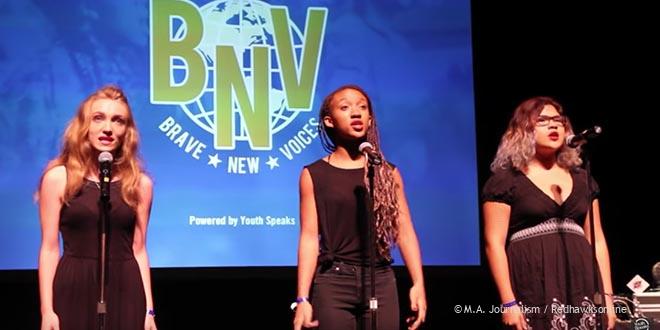

Slam poetry classes and competitions are prominent throughout the whole Twin Cities area, that extends all the way to the national level
They leave spiral notebooks backstage and bring heartache into the spotlight. They strut or squirm or simply wander to the mic with something to say or scream or sing or suddenly proclaim. Rhythm drips from their lips, oozing with injustices and gut-punching realities: their words sting with reality.
They’re poets: slam poets.
Slam poets are competitive spoken-word-poets. Rather than simply reciting stanzas at a poetry reading, slam poets perform for points. They deliver their poetry out loud to an audience, who critiques and ranks their poems based on composition, content, and delivery.
By the end of the slam competition, a winner is recognized.
Slam poetry is often associated with aggressive, passionately verbose speakers, who cut unvarnished images into hearts with sharp words and blunt accusations. Unlike some connotations about -prose poetry- being gentle and infantile, slam poetry is perceived as a forceful form of art. Though some slam poets write about subtle topics, most poets address disturbing truths about personal and societal problems. Slam poets tend to explore ideas regarding injustices with race, sexuality, abuse and depression. Performance poetry has provided an outlet for expression for those who have felt unheard before.
Poetry slams occur at local, regional and national levels: from quaint cafes and school classrooms to massive auditoriums and city streets.
At the local level, the Twin Cities has emerged as a vibrant community of slam and spoken word poetry. The Loft, a literary center in downtown Minneapolis, offers performance poetry classes and occasionally hosts spoken-word shows featuring nationally renowned artists. Weekly open mics are held in cafes and bars across the metro area, such as The ReVerb open mic, which occurs from 6-8 PM every Thursday at Golden Thyme Cafe in St. Paul. On-campus slams are held at colleges like Hamline University, Macalester College, and the University of Minnesota. Lastly, the world’s largest digital spoken word distributor, Button Poetry, is based in Minneapolis and hosts monthly performances and competitions in Camp Bar every first Monday of the month.
At the national level, grand organizations like Poetry Slam Inc. have sponsored championship tournaments for high level slam artists. The National Poetry Slam is the largest annual team orientated slam tournament in the world. 80 teams from the United States, Canada, and various European countries travel to a different host city each summer to compete in the championships, as well as attend poetry workshops throughout the week. The 2016 National Poetry Slam was held in Decatur, Georgia during the month of August.
Though some slams, such as Button Poetry LIVE, are age restricted to 18+ audiences and performers, slam has been taught to youth within classroom walls. In large cities like Chicago, New York City and San Francisco, poetry programs have emerged within schools in lower-income neighborhoods. Global Writes, a non profit organization with the mission to support youth literacy and communication, has brought together professional poets with teachers to co -educate students about slam poetry. Similarly, The Voices of Youth program has organized classroom attention and competitions for high school students.
The sport of slam poetry, combined with the hip-hop and scat-like rhythm of spoken-word poetry, has modernized and ancient form of art. Storytelling, in the form of epic poems and folktales, began with spoken word. Tales like Homer’s Odyssey and Iliad and legends like Hercules, Robin Hood, and Cinderella were preserved through generations of oral tradition. For centuries, the most gripping novels were not novels at all; they were words spoken out loud.
However, with the emergence of widespread literacy and innovated technology, oral tradition decreased in necessity. Historical information could be recorded by the quill of a scribe rather than the tongue of an elder. Captivating stories could be told without a storyteller. Rhymes could be plucked from the air and could fall neatly into the flat pages of a book.
Poetry was revolutionized in the 1940’s by artists of the Beat Generation like novelist Jack Kerouac and poets Allen Ginsberg and Gary Snyder. Discouraged by nature of mainstream society after World War II, the Beat Generation aspired to challenge not only social conformities, but also conventional writing. Poetry was then modernized by the popularized free-verse structure and the compliments of jazz music. Poetry readings stole rhymes off the pages and gave life to poetry.
In 1986, construction worker and poet Marc Smith turned spoken word readings into slam poetry competitions. Smith started with poetry contests based on simple audience reactions, ranking contestants on the — of applause and heckling. These competitions evolved with specific score sheets and a system. Smith brought his new form of poetry to The Green Mill Cocktail Lounge in Chicago and created the Uptown Poetry Slam, which still exists today.