Although some traits seem to be hard-wired, effort and experiences can help us improve
People often say that personality is how you act and perceive the world, but as you grow up, your personality evolves and is described differently. But what changes your personality? Is it your surroundings? Environment? Injuries?
By the time you reach high school, you already have an established personality, but you are still looking to improve.
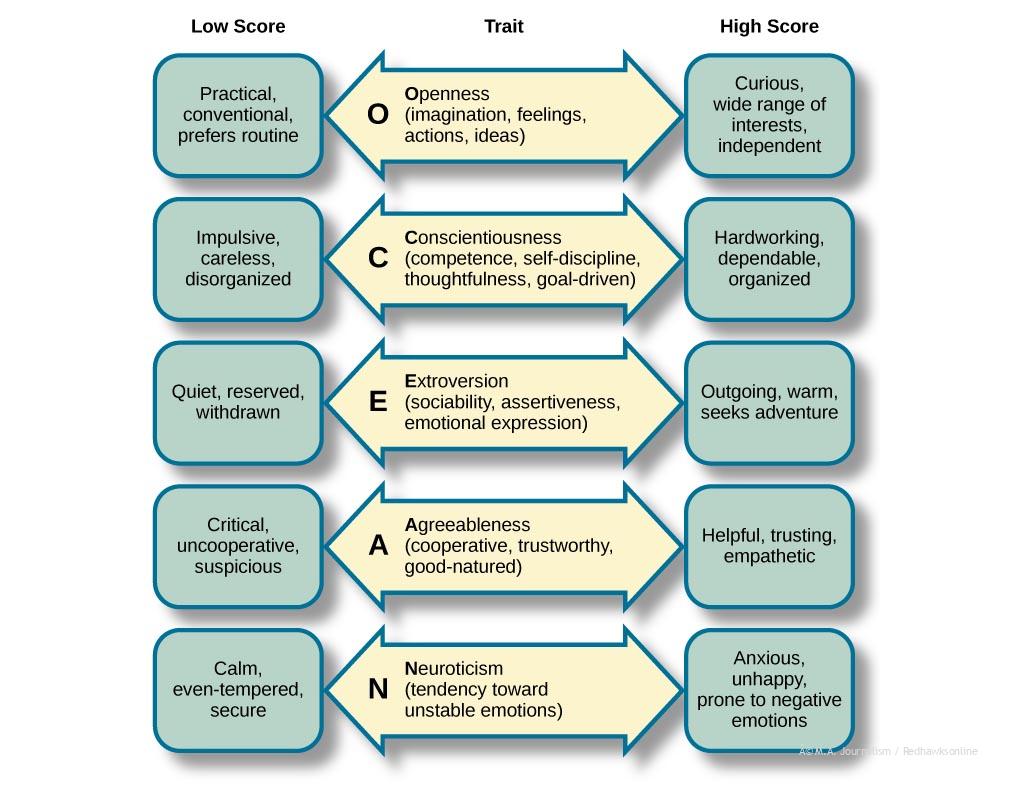
Researchers have described, categorized, and measured our traits into the five major personality traits. They have also summarized them into an acronym: O.C.E.A.N.
Openness is the curiosity to explore differences in what you are used to. This can be shown by being open to new ideas, people, perspectives, and situations. Openness can help you grow as a whole. “[Being] open and willing to learn from others is going to inform your ‘moving forward’, learning and growing,” said M.A. psychology teacher Julie Johnson. “Being open and hearing, listening, and conversing. Because if I’m closed off, I can’t grow from that.”
Conscientiousness is your self-discipline and organization. It is measured by how we discipline ourselves and how determined we are to achieve our goals. This can be shown in athletic and academic prowess.
Extroversion is the measure of self-expression, socialness, and outgoingness. This can be shown by how people present themselves to others. “If I’m really extroverted, [I would] naturally [be] stepping into leadership positions, whereas someone who’s going to be shy or more introverted is more likely to end up on that side of not always saying the things that need to be said,” Joel Johnson, M.A. Christian ethics and Capstone teacher, said.
Agreeableness is a measure of how cooperative people are with others. This can be shown by being helpful, trustworthy, and empathetic towards other people.
Neuroticism is the proneness to experience negative emotions. This can come from experiences and/or upbringing. “So if I’m more prone to be anxious about things, and things keep happening to me that are confusing or unclear, they’re gonna make me more anxious,” said Joel Johnson. “Our life experience, or just for whatever factors, has made us more prone to be pessimistic or angry.”
OCEAN measures our personality traits and how we tend to behave. So how do we change?
Learning to change
A certain number of people want to change their traits. Become more efficient, extroverted, and more open-minded. So where do we start?
“If I could change my personality, I would make it easier to talk to other people,” said first- year, Isaac Mick.
Joel Johnson remembers being in college and how he used to talk a lot of meaningless words. He noticed that one of his mentors spoke a few wise words. He wanted to be more like that, so he began to emulate his mentor.
“I started to become more like the person that I wanted,” he said. “Fake it so you make it, but don’t like, don’t feel like the faking it is like lying to anybody. If you want to make a change, you start pretending like you are more than the person you want to be, and I don’t think it’s inauthentic to do that. I think that’s actually how we become those people.”
Change is a natural part of life, even when it comes to our personalities, said Gabriella Gitobu, a University of Minnesota neuroscience student.
“Personality changes because of experiences [and] it’s just also just a natural part of life and a part of getting older,” she said. “The more you change, the more you’re going to adopt new beliefs and stuff. Also, some people don’t change.”
Who and what you surround yourself with can influence what you believe in and value, which in turn affects your personality. For example, if you are set in a toxic environment, you might tend to think negatively. Brain structure can also take a toll, along with experiences such as medical injuries.
“Our sense of goodness is based on beliefs, values, principles, and norms,” Joel Johnson said. “And I think those norms, like the people that we spend time with, and how our society or our culture shapes expectations, have this kind of circle where we shape those norms, and then those norms shape us.”
But these changes can also come from the people and things you surround yourself with.
“All of us probably have had experiences where we’re part of a community, part of a team, part of some kind of group,” Johnson said. “It starts to shape the ways that the individuals within that group communicate and practice and live their lives for better or for worse. It’s a good reminder to be aware of and wise about who we’re spending a lot of time with, because they’re gonna shape us.”
So, as students go through high school, how would they change their personalities to some extent while still maintaining authenticity?