
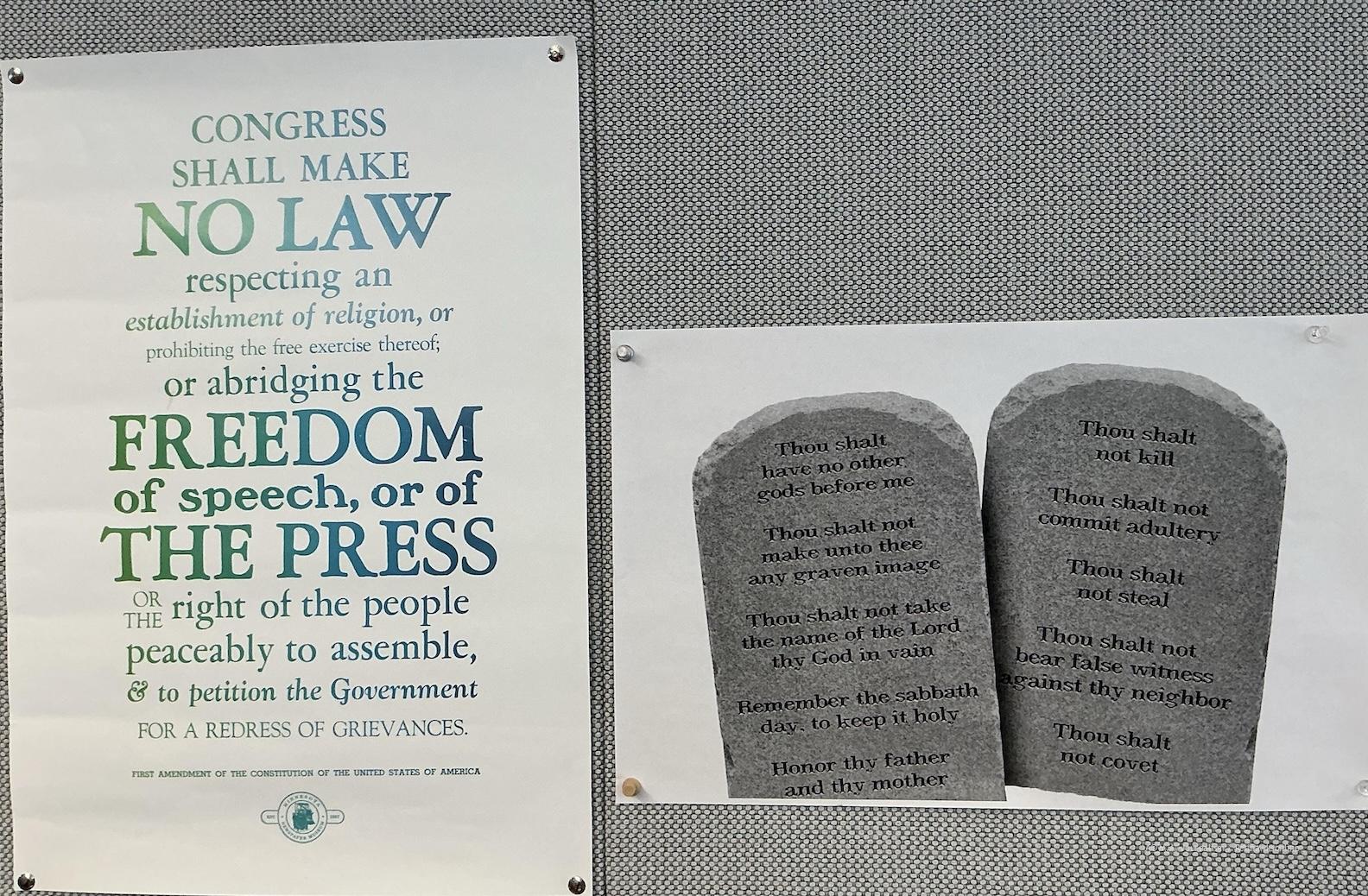

Should displaying the 10 Commandments in public classrooms be considered unconstitutional?
It’s not uncommon to see crosses and Bible verses on the walls of Minnehaha as an independent Christian school, but would you think it acceptable to see them in public classrooms? For some states, that’s a topic of debate.
A few months after President Trump was re-elected for his second term, a handful of states that voted for him in the election began to advocate for a law requiring the display of Christian religious texts in classrooms.
There’s only one problem. Nearly 45 years ago, the Supreme Court ruled that displaying the 10 Commandments in public school classrooms was unconstitutional.
The Establishment Clause of the First Amendment prohibits the government from establishing a national or state religion or holding one more favorably than the rest. Although independent private schools may promote or discourage any specific religion, the Establishment Clause prevents such action in public schools. However, states such as Louisiana, Arkansas, and Texas push those boundaries, having passed laws that mandate the display of the biblical 10 Commandments in public classrooms.
This year, a law was proposed in Arkansas (Act 573) which stated that a copy of the commandments must be “at least sixteen by twenty inches” and “include the text of the Ten Commandments in a size and typeface that is legible to a person with average vision from anywhere in the room in which the durable poster or framed copy is displayed.” Also in 2025, Texas passed Senate Bill 10, which required public schools to conspicuously display the Ten Commandments in every elementary and secondary classroom.
Supporters of these laws argue that the 10 Commandments provide insight into the history and foundation of American law.
“There’s no doubt about the historical and cultural foundations and the significance of the 10 Commandments for our heritage and systems of law,” said Jonathan Saenz, president of a Christian legal advocacy group in Texas, when speaking to The Washington Post. “There’s value for students to have an awareness of those things.”
Supporters also argue that there are moral reasons behind passing these laws.
“It is incumbent on all of us to follow God’s law, and I think that we would be better off if we did,” said Texas State Representative Candy Noble during a debate on this topic in May.
Noble supports incorporating Christian moral values into the education system and believes displaying the Commandments will be beneficial.
Not everyone agrees with these sentiments. John Williams, the legal director of Arkansas’s American Civil Liberties Union and someone very involved in this topic, stated that the law was “unconstitutional” and “trampling families’ First Amendment rights.”
Many agree with this, considering the requirement for biblical texts to be displayed in public schools as a promotion of religion, which breaches the First Amendment’s promise of equality for all religions and the separation of church and state.
Jamie Jurkovich, a Minnehaha history teacher with over 30 years of experience teaching and studying U.S. history and government, offered some insight into these developments.
“The Constitution is clear,” he said. “Congress shall make no law respecting the establishment of religion. [10 Commandments in public classrooms] should be considered unconstitutional. Christianity has been the dominant faith in this country since day one… but [a public classroom] is not the place for it.”
When asked about possible reasons for a sudden resurgence of such religious conflicts, Jurkovich theorized that the so-called MAGA movement may be contributing to a rise of Christian nationalism under the Trump Administration.
“I find it ironic, because if you really understood what America is about, you’d understand and support the Constitution,” said Jurkovich. “Religious groups have always valued their freedom, and that includes non-interference by government—in this case, public schools teaching a religion. They should want to protect their rights.”
Reid Westrem, a journalism teacher who has taught in public schools, commented that most teachers are well aware of the differences between public and private education regarding religion.
“On the back wall of my classroom at Minnehaha, I display the basic principles of journalism ethics alongside the theme verses from this year’s chapels,” he said. “But at Wayzetta, Irondale, or Eagan, where I taught, I would only display the journalism principles.”
Westrem said that even in public schools, the “separation of church and state” is not complete.
“I think I speak for most teachers in saying that your values guide your teaching,” he said. “If you’re a person of faith, you’re going to show compassion for every student, regardless of their background, and you’ll try to give extra support for the vulnerable and marginalized. It doesn’t matter if the Ten Commandments or Beatitudes are on your wall if they’re in your heart.”
Public school teachers may teach about religion, but they may not advocate for any one religion and should strive to remain unbiased in their teaching, he explained.
Currently, the laws requiring the display of the 10 Commandments in public schools are under judicial review. The U.S. Court of Appeals is rehearing Louisiana’s law, and Texas’s is also on appeal after first being blocked from enforcement. As officials deliberate over whether these laws are considered unconstitutional, there is no clear answer as to whether the laws will remain in effect or not.